Shelf Secrets
Tracing Histories of Humboldt University Library Books

Each section of this exhibit was curated by a student member of the 2024-25 Berlin University Alliance X-Student Research Group Seminar "Shelf Secrets" (instructor Dr. Madeline Zehnder). Seminar participants independently selected books from the HU library and spent the semester researching their books—while also studying foundational book historical concepts and methods, discussing new research in the field, and experimenting with the art of letterpress printing.
Although the exhibit's different curators take different approaches to analyzing their books, each section below is organized by three shared categories: Origins, Design, and Readers & Uses.
Books and curators:
- Histoire du siècle 1789-1889 (Paris, 1889)—Lili Csóti
- Wanderungen und Gedanken. 2. Comte und die Göttin Clotilde (Berlin, 1921)—Lea Weiß
- Plakat Handbuch. Jacques Albacharys Führer durch das Plakatwesen (Berlin, 1928)—Emma Budahn
- Of Human Bondage (London, 1938)—Tristan Brennwald
- Taʾrīḫ al-ḫaṭţ al-ʿarabī wa-ādābuhu (Cairo, 1939)—Polina Shablovskaia
- Hitler Sobre America Latina (Mexico D.F., 1968)—Sofía Comelatto
- Alice's Adventures Under Ground (London, 1985)—Emmeli Jessat


Humboldt University was founded in 1810 as the University of Berlin. As different library stamps visible in this exhibit's books illustrate, the university has undergone several name changes over the course of its history. From 1828 to 1945, the institution was known as Friedrich Wilhelm University. From 1945 to 1949, it was once again called the University of Berlin. And since 1949, it has been known as the Humboldt University of Berlin.1
- Humboldt-Universität zu Berlin, "Geschichte der Humboldt-Universität zu Berlin," last modified 18 May 2016.

Book acquisition is not always a neutral process. From 1933 to 1945, university library acquisitions included materials looted by the Nazi regime. As of 2025, research to identify looted books in the Humboldt University library is still ongoing.
Surprisingly, the library's collection survived World War Two with relatively little damage. The library was also unaffected by an infamous 1933 Bebelplatz book burning, which Nazis orchestrated across the street from Humboldt's main building. Titles burned during this event remained on Humboldt library shelves, as did books by authors critical of the regime—such as Max Hochdorf, whose Comte und die Göttin Clotilde features in this exhibit.

Today, the Humboldt University library operates as a centralized system that consists of a main library (the Jacob and Wilhelm Grimm Center) and nine branch libraries. Books in this exhibit are primarily housed in the Grimm Center, with the exception of Alice's Adventures Under Ground (Foreign Languages/Literatures Branch Library) and Taʾrīḫ al-ḫaṭţ al-ʿarabī wa-ādābuhu (Asian-/African Studies and Islamic Theology Branch Library).
As the university's library has evolved, so have its systems of organizing, storing, and recording information about its books. Thanks to the foresight of Humboldt librarians, the library's pre-digital catalogues have been largely preserved—and have made valuable sources of information for research on the older books included in this exhibit.

The Books
- Histoire du siècle 1789-1889 (Paris, 1889)
- Comte und die Göttin Clotilde (Berlin, 1921)
- Plakat Handbuch (Berlin, 1928)
- Of Human Bondage (London, 1938)
- Taʾrīḫ al-ḫaṭţ al-ʿarabī wa-ādābuhu (Cairo, 1939)
- Hitler Sobre America Latina (Mexico D.F., 1968)
- Alice's Adventures Under Ground (London, 1985)
01
Histoire du siècle 1789-1889 (1889)

A memory from 1889 in the HU library
Walking through the maze of shelves in HU's central library, you will find a wide variety of books. In some corridors, where the only other human being you are likely to meet is a librarian, bundles of obscure journals, old book series, and encyclopedias sit on shelves so lonely that your mere presence stirs the dust on them. But there are also sections of the library where mysterious older volumes hide among modern bindings of different sizes and bright colors.
That's how this book caught my eye—a slim, worn, leather-bound volume with gilt flowers on the spine and no author inscription, just a title and a date: Histoire du siècle 1789-1889.
The Histoire du siècle is the oldest book on its shelf; its neighbors were all published after 1987. Their subject matter is mainly French history and genre painting or political iconography. However, unlike the book profiled in this section, they are all academic works by art historians. In comparison, the Histoire du siècle seems more like a work of art itself.

To hold the Historie du siècle is to hold a delicate and elegant artifact that needs to be handled with care. With its thin, aged pages, the book is as fragile as the small gold flowers that decorate its spine.
Inside the book, the red-black-yellow marbled endpaper bears the bookplate of one Princess Radziwill, offering a glimpse into this particular book's unique past.

This publication was originally a guide to the monumental panoramic painting of the same title in the Jardin des Tuileries for the Paris Exposition of 1889.1 Here, this magnificent work of art is reduced to a pocket-sized, portable form. The book's text, which is only 17 pages long, is accompanied by 24 illustrations, which each form 12 pairs: a detailed lithograph and an explanatory figure. On the book's title page, the names of the two painters appear first, with the text author's name following behind them.
- Danielle Derrey-Capon et al., Alfred Stevens (1823-1906) et Le Panorama de l’Histoire Du Siècle (Ghent: Snoeck, 2009), 137, 131.


1889, Paris
The Eiffel Tower, a monument that will soon become the symbol of the city, has just been built. At its foot, the so-called Exposition Universelle, or Paris Exposition, has opened its doors to the public. Visitors arrive from around the world to participate, exhibit, or just enjoy the festivities, inventions, and art. The organizing French, celebrating the centenary of the French Revolution, aim to make a strong impression on visitors, seeking not only to provide a place to exhibit and experience the progress of mankind, but also to showcase the power of the country. One of the attractions designed to reaffirm France's stability and strength was the panoramic painting by Alfred Stevens and Henri Gervex entitled Historie du siècle.


A gigantic painting in a small book
Histoire du siècle is a surviving artifact from a historical event that most people have no connection with today. But when we hold it in our hands, the book invites us to feel part of a celebration that took place more than 130 years ago, echoing how the panorama itself once invited visitors to feel a sense of inclusion in the painting around them. This effect is achieved by a number of design choices.
The title page immediately introduces the two leading painters of the project, Alfred Stevens and Henri Gervex, under the capitalized title "Peinture" ("Painting"), making it clear that they are the main creators of this publication. The panorama is reproduced in twelve images. Together with the accompanying explanatory drawings, which enable the visitor to identify the many figures in the painting, the images are undoubtedly the most important part of the publication. They are printed on thick white paper, with two full pages for each pair of photographs and diagrams—one for the reproduction itself and one for the accompanying explanations.


The foreword
The reproductions and explanatory drawings were not the only elements that helped visitors navigate the monumental artwork. The opening words are written by Joseph Reinach, the French politician, journalist and essayist. His short text reads like a commentary on the painting and surveys the cast of characters who appear in the panorama—the most prominent French personalities of the preceding century, who are all shown attending a lavish garden party.
Within Reinach's text, the names of the characters stand out from the text in capital letters, making it clear when a person is mentioned who can also be discovered in the panorama. The pages of this half of the book are made of a thinner paper that indexes the passage of time: unlike the snow-white pages of the lithographs, these pages have yellowed in the 130 years that have passed since the guide was published.


.jpg)
A special owner: Princess Radziwill
Although the primary function of this publication was to guide Exposition visitors through all 120 meters and some 660 figures of the Panorama, it also served a secondary, souvenir-like role. While the booklet is a condensed, mass-produced reduction of the original, its quality, obvious attention to detail, and even the foreword written by a prominent French politician show that it was always intended to be more than a disposable guide. The fact that the original owner of the Humboldt copy, Princess Radziwill, kept the book and added it to her personal library also supports this theory.
The princess was born Marie Dorothée Élisabeth de Castellane in 1840. She was a French aristocrat who in 1857 married Prince Antoni Wilhelm Radziwill, an important member of both the Polish-Lithuanian nobility and the Prussian army. She is considered one of the most influential female figures of her time, having shaped the political and cultural landscape of Berlin with her salon.1
Such a prominent owner raises the question: are there any sisters of the Histoire du siècle somewhere in the library? The answer is yes, and these books shed even more light on how this particular book, which is almost a work of art itself, ended up on the open shelves of a university library.
- For more information on her life see Günter Erbe, Das vornehme Berlin: Fürstin Marie Radziwill und die großen Damen der Gesellschaft 1871–1918 (Köln: Böhlau, 2015).


Dr. Lautenschläger
Alois Lautenschläger is the person whose bookplate appears in three other Radziwill books. These bookplates state "Vermächtnis des Dr. med. Alois Maria Lautenschläger in Berlin–Grünewald" ("bequest of Dr. med. Alois Maria Lautenschläger in Berlin-Grünewald"). He was a Berlin-based otolaryngologist and art collector practicing in the first half of the twentieth century.1 As a member of the Nazi Party, he held a secure position that allowed him to collect and retain artifacts ranging from rare books to paintings.2
The presence of his bookplate in these three books (Lettere edite ed inedite di Camillo Cavour, Lettres du maréchal, and Mémoires de la Ctesse. Potocka) and one with the note from the librarian (Joachim Murat) suggest that these copies first came into the possession of the doctor and then, after his death, were donated to the library as part of his estate around 1944.3 However, the situation is further complicated by the fact that not all of the books that once belonged to the princess—the Histoire du siècle among them—bear Lautenschläger's bookplate.
- Aschaffenburg Online, "Aloys Maria Lautenschläger" (accessed 24 January 2025).
- For more information see Aschaffenburg City Archive, "Dossier Aloys Lautenschläger" (accessed 7 March 2025).
- For providing the books' arrival dates I thank Henrik Hofer from the Sondersammlungen of the Humboldt University library.


An honorary HU Professor
While tracing the history of all the books originating from Princess Radziwill seems challenging at this point, the Histoire du siècle itself offer one more clue: just above the stamp of the Humboldt University Library is another, barely legible one: "Bibliothek Buddensieg."
Tilmann Buddensieg was a renowned German art historian who became an honorary professor at Humboldt University in 1955. He died in 2013, so it is possible that the book of Princess Radziwill entered the Humboldt Library either after his passing or as a donation to the institution of which he was an honorary professor.
Conclusion
02
Comte und die Göttin Clotilde (1921)
Introduction
While I was looking for a different book, I found Comte und die Göttin Clotilde by accident. What first caught my eye was a group of small books crowded together on an open library shelf, which I would later discover belonged to a series known as the Orplidbücher. Of those nearly fifty books, I was drawn to this one because of its title: Auguste Comte is an important name in the history of sociology, and I hoped to find content related to that subject. The book instead contained essays including a book review of a humorous novel about Comte—but at this point I was already interested in the many other questions that this book posed.
I wanted to know about the author behind the book, Max Hochdorf, whose work was banned in Nazi Germany and seems mostly forgotten today. What was his connection to Berlin and its intellectual circles in the late 1910s and early 1920s? What made him publish with Axel Juncker, particularly since Hochdorf was one of the only authors who published in the series multiple times?
I also wondered about the Orplidbücher. What was the history of this series and how did it relate to the publishing culture of the time? Why was it discontinued, while other series such as the "Insel Library" became very popular? What was behind the small, handy format in combination with the books' rather elaborate design? Were they made with a specific audience in mind? What also struck me was the bad shape that many of the other Orplidbücher were in, raising questions about the history of this particular collection at HU.
Humboldt's copy of Comte und die Göttin Clotilde is a first edition that the university library purchased shortly after the book was published. According to WorldCat, other copies can be found in Berlin (Staatsbibliothek), Leipzig (Deutsche Nationalbibliothek), Erlangen (Universitätsbibliothek), Munich (Bayerische Staatsbibliothek) and, interestingly, Brighton (Sussex University Library). During the project, old library catalogues and accession journals answered some of my questions, while labels in the book itself posed new questions about the history of the Humboldt University library's collection.

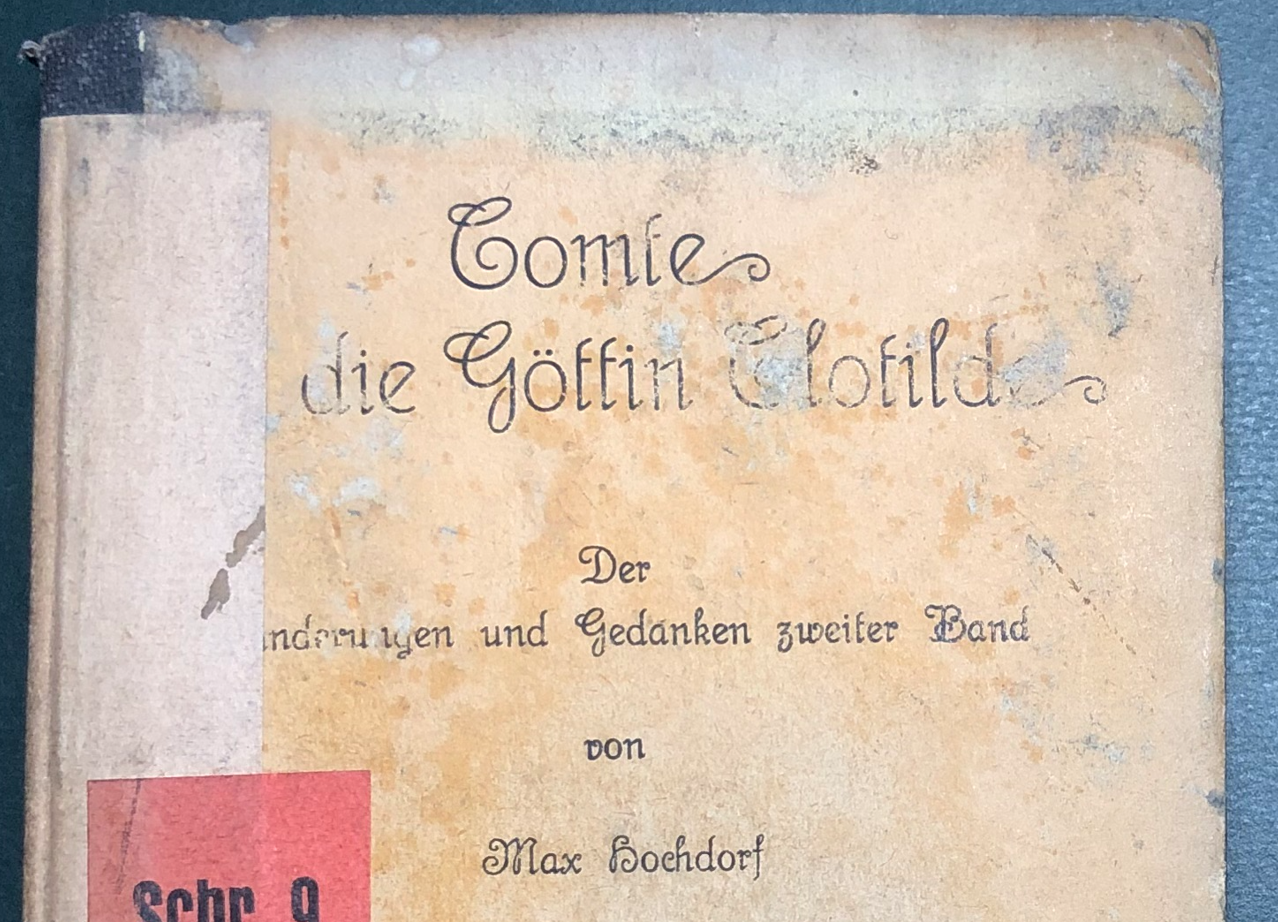
Comte and the Goddess Clotilde
Comte und die Göttin Clotilde. Der Wanderungen und Gedanken zweiter Band ("Comte and the Goddess Clotilde. Rambles and Thoughts, Volume 2") was published in 1921 by Axel Juncker in Berlin-Charlottenburg.1 It is the second of two connected collections of essays written by the author Max Hochdorf.2 Printed by the long-standing printing house Dietsch & Brückner in Weimar, the book is volume 45 in the series Orplidbücher, which published prose, poetry, essays, and illustrations in a distinctive small format until the mid-1920s.3
- Translations from German to English by Lea Weiß.
- The first volume: Max Hochdorf, Wanderungen und Gedanken. Die letzte Tat des Jean Jaurès (Berlin: Axel Juncker Verlag, 1919).
- Michael Knoche, "Wie sich ein Privatverlag in der sowjetischen Besatzungszone behauptete – Hermann Böhlau Nachf., Weimar," October 1, 2018.

Max Hochdorf: A novelist, journalist, and theater critic
Max Hochdorf (1880-1948) was a German-Jewish writer, playwright, translator, and theater critic. Born in Szczecin, Pomerania, he studied law and Slavic studies in Munich and Genoa and graduated in Fribourg with a dissertation on Gottfried Keller.1 His early published literary work is mainly prose. Between 1909 and 1913, he published four novels. Works including Das Leiden der Simoni (Berlin: Axel Juncker, 1910) and Die Träume der Nathalie Braunstein (Berlin: Egon Fleischel & Co., 1912) address topics of Jewish life in Germany between assimilation and discrimination.2 As literary scholar and historian Itta Shedletzky notes, literary discussions of the ideal Jewish novel took place in German-Jewish magazines from the popularization of the novel in the 1870s until the mid-1910s.3 In a 1911 issue of the Allgemeine Zeitung des Judenthums, literary critic Ludwig Geiger would remark of Hochdorf : "A pity that the author wastes his certainly existing great talent on such sketches [....] Maybe he has what it takes to write the Jewish novel we have long hoped for."4 Instead, Hochdorf moved to Berlin and started to publish short stories, translations, and essays—among others, the two volumes of Wanderungen und Gedanken.
Hochdorf's time in Berlin lasted from 1918 to 1933, when he emigrated to Belgium due to the Nazi takeover of power. In the mid-1920s, Hochdorf was active as a playwright, with productions in Lübeck, Neubrandenburg, Kottbus, and Berlin.5 An anonymous theater critic characterizes Hochdorf "as a seeker, inexpert and free, who searches only by the probe of his rich experience, behind all things the heart of men and the meaning of the world."6 In Berlin, Hochdorf's involvement with the theater world was manifold: he managed the press for for the Guild of the German Stage (GDBA) and was a theater critic for Vorwärts, the central organ of the Social Democratic Party of Germany (SPD).
In the 1930s, amid the Nazi party's rise, Hochdorf's literary work became political and admonitory. In 1930, he published Die große Trommel. Leben, Kampf und Traumlallen Adolf Hitlers (Berlin/Zürich: Deutsch-Schweizerische Verlagsanstalt), a psychogram and political analysis of Hitler and "an attack on National Socialism," under a pseudonym.7 At the same time, he turned to the history of socialism: Rosa Luxemburg: Das Leben einer Revolutionärin (Berlin: Verlag der Neuen Gesellschaft, 1930) and August Bebel: Geschichte einer politischen Vernunft (Berlin: Verlag für Kulturpolitik, 1932) are both biographies of important socialist figures.
In 1933, after the Nazi takeover, Max Hochdorf emigrated to Belgium and later, in 1936, to Ascona, Switzerland. In 1938, his writing was forbidden in Nazi Germany.8 In 1940, his wife Erna Hochdorf, born Olsen, was officially deprived of citizenship.9 In 1941, he returned to Belgium, where he lived in Brussels under a false name until 1944. During this time, he continued his journalistic work and wrote serials for the German-language exile newspaper Pariser Tageblatt, later Pariser Tageszeitung.10 After his death in 1948, his friend Manfred George honored his extensive work: "what seems impossible in this country, that someone is at the same time expert for foreign affairs and plays, was in the Hochdorf generation the prerequisite of a journalist."11
- Max Hochdorf, Zum geistigen Bilde Gottfried Kellers (Zürich: Amalthea-Verlag, 1919).
- Archiv Bibliographica Judaica, eds., Lexikon deutsch-jüdischer Autoren. Band 12, Hirs – Jaco (München: K. G. Saur, 2008), 118.
- Itta Shedletzky, Literaturdiskussion und Belletristik in den jüdischen Zeitschriften in Deutschland 1937-1918 (Dissertation, Hebrew University Jerusalem, 1986), 140.
- "Schade, dass der Verfasser seine sicherlich vorhandene große Begabung an solchen unangeführten Skizzen verschwendet [....] Vielleicht besäße er das Zeug, den jüdischen Roman zu schreiben, den wir seit langem erhoffen." Ludwig Geiger, "Max Hochdorf. Die Leiden der Simoni," Allgemeine Zeitung des Judenthums 38 (1911): 456.
- Lexikon deutsch-jüdischer Autoren, 12:120-121.
- "Als ein Sucher, der unfachlich und frei, nur mit der Sonde seiner reichen Erfahrung, hinter allen Dingen das Herz des Menschen und den Sinn der Welt sucht." Quoted in Lexikon deutsch-jüdischer Autoren, 12:120.
- Hannah Caplan and Belinda Rosenblatt, eds., International Biographical Dictionary of Central European Emigrés 1933-1945. Volume II / Part 1: A – K. The Arts, Sciences, and Literature (München/New York/London/Paris: K. G. Saur, 1983), 522. In 2022, Hochdorf's study was rediscovered and republished as Tacitus Revividus, Die große Trommel: Leben, Kampf und Traumlallen Adolf Hitlers (Darmstadt: wbg Theiss, 2022).
- CODING DA VINCI, "Verbannte und Verbrannte. Die Liste der im Nationalsozialismus verbotenen Publikationen, Autoren und Verlage" (2014). Entry for Max Hochdorf (accessed 28 February 2025).
- United States Holocaust Memorial Museum, Holocaust Survivors and Victims Database. Entry for Erna Hochdorf (accessed 28 February 2025).
- Lexikon deutsch-jüdischer Autoren, 12:116-122.
- "Was hier bei uns im Lande kaum möglich scheint, dass nämlich jemand Fachmann für Dramen und für Aussenpolitik zugleich ist, das war bei der Hochdorf-Generation die Voraussetzung eines Journalisten." Aufbau: an American weekly published in New York (27 February 1948), 5. Accessible via Deutsches Zeitungsportal.
Axel Juncker: The publisher
Comte und die Göttin Clotilde was published by Axel Juncker (1870-1952), who led a publishing house in Berlin. Born in Copenhagen, Axel Juncker focused on Scandinavian authors as well as aesthetic and avant garde literature. He founded his publishing house 1902 in Stuttgart before moving to Berlin. In Berlin, he led the Scandinavian Bookshop that was highly valued by Rainer Maria Rilke, who was a frequent costumer and later published by Axel Juncker. Other writers Juncker published include Max Brod, Max Dautheney, Agnes Henningsen, Søren Kierkegaard, Toni Schwabe, René Schickele, Else Lasker-Schüler, Kurt Tucholsky, and Anton Wildgans.1
- Supplement to the papers of Axel Juncker, Staatsbibliothek zu Berlin (DE-611-BF-1455).


The publishing house was based at Sybelstraße 11 in Berlin-Charlottenburg. In 1912, Juncker opened a bookshop on Kurfürstendamm, which was a meeting point for Berlin intellectuals.1 Still, his relationship to Max Hochdorf remains uncertain, though both share biographical connections to Denmark, as both Axel Juncker and Erna Olsen, Hochdorf's wife, were born in Copenhagen. Hochdorf's first novel Das Herz des Little Pu was published by Axel Juncker in 1909. Other works followed in 1910, 1918, and 1919. Comte und die Göttin Clotilde in 1921 seems to mark the end of this author-publisher relationship.
- Supplement to the papers of Axel Juncker.

Axel Juncker published the small-format book series Orplidbücher from 1912 onwards in more than fifty titles.1 Orplid refers to a paradisical fantasy country invented by the poet Eduard Mörike (1804-1975).2 The first Orplidbuch was a new translation by Toni Schwabe of the novella Kormak und Stengerde by the Danish author J. P. Jacobsen, who was of great influence for Rainer Maria Rilke.3 Max Hochdorf's Comte und die Göttin Clotilde is the forty-fifth of the Orplidbücher. The series, which featured poetry, novellas, essays, fables and illustrations, was continued until Juncker moved back to Copenhagen in 1924.4
- Thorsten Unger, ed., Weltliteratur – Feldliteratur: Buchreihen des Ersten Weltkriegs; eine Ausstellung (Hannover: Wehrhahn, 2015), 58.
- Unger, Weltliteratur, 59.
- Orplid 1, no. 2 (Berlin: Axel Juncker, 1912); Rainer Maria Rilke, Briefe an einen jungen Dichter (Berlin: Insel, 1929).
- Supplement to the papers of Axel Juncker.

The Orplidbücher series had an elegant yet modern aesthetic. Small in size and narrow in width, the format Juncker selected lent itself well to shorter literary forms such as poetry, the novella, and the essay—a form that at the beginning of the twentieth century was deemed fitting for the radical openness and uncertainty of modern times.1 Comte und die Göttin Clotilde—an essay collection—counts 117 pages. The first four essays are book reviews. Hochdorf's aspiration as a culture critic becomes especially visible in the last text, which is a reflection on contemporary dance.
- On the essay as form, see Birgit Nübel, Robert Musil – Essayismus als Selbstreflexion der Moderne (Berlin/New York: Walter de Gruyter, 2006).
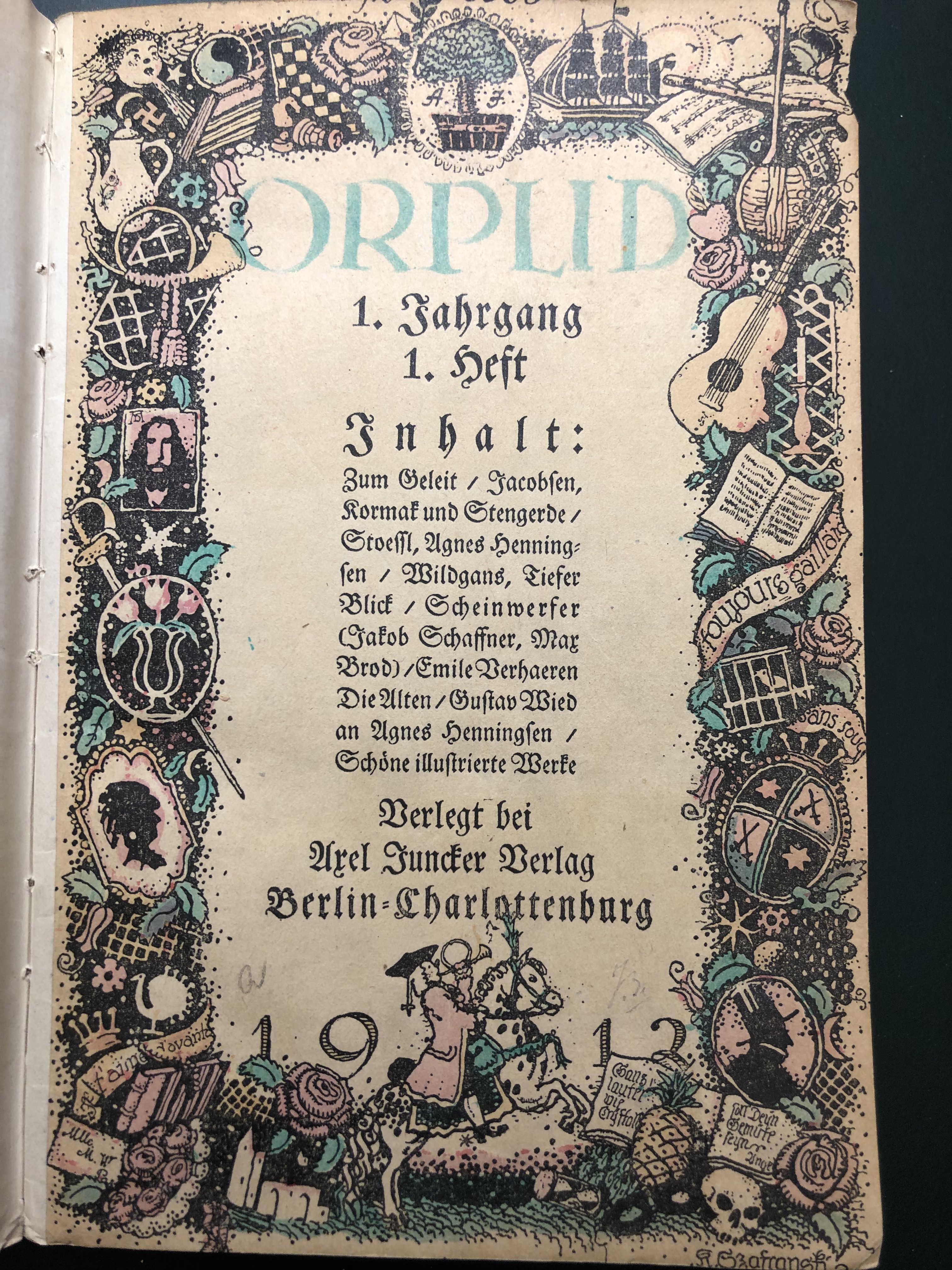
The Orplidbücher series: Handy books as gifts and collectibles
The series' third title, Kurt Tucholsky's Ein Bilderbuch für Verliebte, soon became a bestseller. Its illustrator Kurt Szafranski also designed the title page of Orplid, a literary magazine published by Axel Juncker in 1912 and 1913, in part with the aim to advertise the new Orplidbücher series. A 1912 advertisement proposes Orplidbücher as small gifts for congratulations and indicates that the series targeted a bibliophilic audience: "These small, pretty booklets of our Orplid-Bücher sit in colourful cardboard boxes, paperbacked and ready for delivery, and can be sent everywhere as printed matter."1
- "Diese kleinen Bändchen unserer Orplid–Bücher liegen mit kleinen, hübschen Glückwunschkärtchen fertig kartonniert und versandbereit in bunten Pappkartons, die Sie überallhin als Drucksache senden können." Orplid 1, no. 1 (Berlin: Axel Juncker, 1912), 47.


Taking a look at the HU library's accession book shows that Comte und die Göttin Clotilde was purchased on November 3, 1921 as part of a bundle of books from the Axel Juncker publishing house along with several other volumes of the Orplidbücher. At that time, the library was still called Universitäts-Bibliothek Berlin and held the obligation to collect publications relevant for Berlin and Brandenburg as legal deposits.1
- I thank Susanne Graß of the HU library for this information.


What remains uncertain is the meaning of the red label on the book's front cover, which indicates storage of the book in "Reserveschrank 9" ("auxiliary cabinet no. 9"). Looking at the other Orplidbücher, seven books of this series, Max Hochdorf's work included, were banned during the Nazi reign of terror; four of them are marked with the same label. To this date, no literature exists about the history of this cabinet in the Humboldt University library collection. Evidence suggests it was used to store books separately, possibly for political reasons.1
- For this information I thank Dr. Yong-Mi Rauch at the Historical- and Special Collections of the Humboldt University library.
Conclusion
03
Plakat Handbuch (1928)


The poster as an advertising medium plays a crucial role in the Plakat Handbuch. The book repeatedly emphasizes that the impact of posters is often underestimated. Today, posters are broadly established in the urban landscape and hang on every corner, yet they often go unnoticed, serving mostly as background noise.
Under the editorial direction of E. O. Erdmenger, who supervised the book's production, the Handbuch conveys the significance of posters in a humorous way, playfully introducing the reader to the world of poster art while skillfully using rhetorical devices and metaphors—such as the "10 Commandments of Billposting" or the remark that one cannot simply wait for a "Poster Messiah."1
The work's confident and engaging tone makes it a pleasure to read and captivates readers from the very first pages.
- Plakat Handbuch, 140-41.

Publishing History
In 1928, Jacques Albachary GmbH published Plakat Handbuch. Albacharys Führer durch das Plakatwesen in Berlin. The book provides a comprehensive overview of German and international poster art of the time. In addition to legal guidelines and economic aspects, it examines the fundamental rules and processes of poster production.
Albachary GmbH, listed as the publisher on the first pages, was an advertising agency based at Potsdamer Straße 122 in Berlin.1 It was registered in the Berlin commercial register in 1904 as Annoncen-Expedition Jacques Albachary, GmbH and was taken over by Willy Loewitt in 1934. Around 1937, the agency was dissolved. Additionally, there is another entry in the commercial register for Plakatanschlag-Vermittlung Jacques Albachary GmbH, which was located at Potsdamer Straße 35.2
Several companies were involved in the publication of the Plakat Handbuch. Editorial management was handled by E. O. Erdmenger (who was also responsible for the editorial direction of other Jacques Albachary GmbH books), with Herbert Zastrow as the chief editor.3 Erdmenger also released magazines and periodicals, such as Schwert und Spaten, which focused on the German arms industry, and Orden und Ehrenzeichen.
Two Berlin-based printing companies were responsible for printing the book: Curt Hamelsche Druckerei und Verlagsanstalt and Gebr. Hartkopf GmbH, the latter being responsible for printing the book cover.4 The building of the Curt Hamelsche printing house, located at Hallerstraße 1, still exists today but is now used as an office building.5
The statistics in the second part of the book were compiled by Willy Marotzke, while the stereotype printing plates (Klischees) were produced by Dr. Selle & Co. AG. The bookbinding was handled by D. Bleistein GmbH, which was headquartered at Friedrichstraße 16.6 Interestingly, all the companies involved in the publication were located in close proximity, highlighting the strong network of the advertising and printing industry within Berlin.
- Plakat Handbuch, title page (recto).
- “Annoncen-Expedition Jacques Albachary, GmbH,” Jewish Businesses in Berlin 1930-1945, accessed 23 February 2025.
- Plakat Handbuch, title page (verso).
- Plakat Handbuch, title page (verso).
- "Curt Hamelsche Druckerei Berlin," Architekturbildarchive, accessed 10 January 2025.
- Plakat Handbuch, title page (verso).


Rolf Frey: The cover artist
The cover of the work was designed by the Atelier Trias under the direction of Austrian graphic designer Rolf Frey. From 1920 to 1924, Frey managed the graphic studio Kosel-F (also called Cosl-F) together with Hermann Cosel. In its early years, the studio specialized in designing packaging for razor blades and cigarette papers.
Frey and Cosel were in close contact with Austrian graphic artist Julius Klinger, who invited them to collaborate on his book Poster Art in Vienna (1923). This book analyzed Austrian poster art but was adapted for the American market.
In 1925, Frey founded Atelier Trias together with Wilhelm Willrab and Klinger to design window display mannequins for the Betterway Grotesken. These figures of animals were used for window displays in stores and then exhibited at the advertising fairs in Berlin and Leipzig. Due to the success of these exhibitions, Frey moved to Berlin, where he continued to run Atelier Trias.
As Klinger's stylistic influence gradually faded, Frey developed his own distinct style, strongly influenced by Art Deco. During the Weimar Republic, Atelier Trias was well established in Berlin. Among its notable projects was the design of one of the first large-scale advertising billboards for Galeries Lafayette at Potsdamer Platz, featuring a woman promoting soap. Another significant project was the three-dimensional illuminated advertisement on the tower of the Amerikahaus for the radio manufacturer Telefunken.
After the Nazis took over, Frey returned to Vienna. His style remained heavily influenced by Art Deco. He favored red and black in his work, simplified forms, and directed the viewer's attention to essential elements.1
- Maryška, "Frey, Rolf," 524.

When you pick up the Handbuch, you immediately notice the simple but striking design of the cover designed by Rolf Frey. In the center is a red Litfaßsäule, or advertising pillar, holding two golden apples. Its bold red color makes it stand out against the brown background and is echoed by the book's red page edges. On the back of the book is an owl in the same red coloring, underneath which is written: UHU-Das Neue Ullstein Magazin.
Frey's deliberate choice of color and the simplicity of the design immediately attract attention, while his depiction of the Litfaßsäule refers directly to the content of the book without overloading the reader with additional information. With this design, Frey shows his flair for conveying simple and direct messages in advertising.
The book itself is of a handy and practical size (23 cm) and weighs around 700 g, making it well suited for transportation and regular carrying. It has not been rebound, but the original cloth binding has been retained.1
Despite its age, it has remained in good condition, with no noticeable signs of wear such as dog eared-pages. The paper is smooth and of a pleasant thickness. All these features suggest that this particular book has not been used intensively, but has been carefully stored.
- Compare to copies currently for sale.

Content
Now to the "catalog" itself. The book's text is divided into editorial and statistical sections. The editorial section offers a comprehensive overview of German and international poster art. It provides detailed information on various printing techniques, including letterpress and gravure printing. In addition, it explains legal guidelines for poster production and discusses the calculation of poster sizes.1
The second part of the work focuses on statistics that deal in particular with the number of advertising panels and columns per inhabitant in German cities. These panels originally were established by authorities to reduce the spreading of posters all around German cities and control the number of posters.2
The book is also divided into small chapters throughout. Written in approachable language, these are kept short and informative. Some chapters include text written by well-known individuals, such as Professor H. K. Frenzel, reflecting Albachary's position in and opinions about the advertisement world.
- Plakat Handbuch, 3-5.
- Johannes Kamps, "Geschichte der Printmedien und ihrer Erforschung XIII: das Plakat I: Herstellung, Vertrieb und Forschungsgeschichte. Herstellung und Verteilung des Plakats in seiner Entwickelung," in Handbücher zur Sprach- und Kommunikationswissenschaft 15, no. 1 (1999): 977.


Posters
Shifting focus from the book's text to its images reveals that is not just Erdmenger's concise and ironic explanations that shape the reading experiences, but also the deliberate use of placards and illustrations that bring the book to life.
In the first part of the book, there is a particularly large number of posters—both German and international. The German advertisement posters are presented without additional explanations as part of a visual showcase, while the international posters are accompanied by texts on the history of posters in advertising and well-known artists in the industry, highlighting difficulties and discussing differences within each country in neutral language.
Many of these images are not only attention-grabbing but serve to promote various German businesses, subtly providing additional information to readers about ads and their production. Although these posters vary in design and subject matter, they offer valuable insights into the work of different companies and their approach to advertisement during the 1920s.

Looking at these posters, we easily can spot differences from the previous German posters. Here, we find a collection of designs and drafts created for the London & North Eastern Railway. These posters advertise different train routes, highlighting beautiful destinations in order to encourage travel by train. They appear mesmerizing and picturesque, reminiscent of vintage postcards. Even the typography used is thin, elegant, and in some cases ornately designed.

The German posters, on the other hand, tend to be simpler in their appearance. Most of them lack intricate motifs, relying instead on caricatures and smaller illustrations. Some posters rely purely on bold fonts to grab attention and convey essential information in an instant.
This is also a point that Professor Frenzel, the publisher of the "Gebrauchsgraphik," conveys in "Was schätzt das Ausland an der deutschen Werbegraphik" ("What other countries prize about German advertising graphics"), which is reproduced in the Plakat Handbuch. He states that every country has its own artistic understanding, arguing that Germans favor design oriented toward intellectual matters, which he claims are better remembered by audiences, rather than opulent aesthetics.1
In some sense Frenzel's comments capture the very design of the Plakat Handbuch itself: the book's simple format and layout seeks to reinforce the text's most important information.
- Plakat Handbuch, 40.

This handbook is more than just a plain textbook; it facilitates easier access to artists working within the design industry by including a "Plakatkünstlerverzeichnis" ("placard artist register") that fosters interactions between designers and potential clients. Through lists and tables, Albachary GmbH presents such information in a structured and accessible manner.

A defining characteristic of the book is its second part, as Albachary GmbH primarily focused on advertising statistics and regularly published magazines featuring new figures and updates concerning the advertisement industry.
In this regard, the Plakat Handbuch differs from other publications by the Albachary GmbH. For example the Albachary Handbuch für den Bogenanschlag consists solely of statistics and tables for each German state and its cities. It includes data on industrial and manual labor sectors, advertising costs and available advertising spaces.1 It should be noted that the term Bogenanschlag was introduced by the Werberat der Deutschen Wirtschaft ("Advertising Council of the German Economy") during the Nazi era and remains in use today.2 Unlike the Plakat Handbuch, this publication conveys information with minimal text, offering only a short preface and brief descriptions.
This approach highlights the publisher's dedication to creating informative and accessible materials. The Albachary handbooks were designed not only to support newcomers in the field, but also to keep industrial professionals informed. The book portrays complex topics with ease, serving both as an objective reference guide and consulting tool. By regularly updating its catalogs with new data and trends, the publisher ensured that advertisers could stay up to date with the evolving industry.
- Albachary Handbuch für den Bogenanschlag (Berlin: Jacques Albachary, 1935), 49.
- Kamps, "Geschichte der Printmedien und ihrer Erforschung," 978.

Before it came to HU, this book was part of the Bibliothek der Industrie- und Handelskammer zu Berlin and therefore belonged to the Industrie- and Handelskammer zu Berlin ("Berlin Chamber of Commerce and Industry"). The book was used by students at that institution before arriving at Humboldt, where it was first listed as a permanent loan to HU in August 11, 1988.1 The longstanding use of this book as a reference work demonstrates the historic impact of Albachary's works on the market and their major role within the advertisement world.
On the title page, as well as in the preface (p. 3), we find five stamps from the IHK Bibliothek. Some of these stamps also appear inside the book; all of the older, round stamps feature the Deutscher Reichsadler.
- HU librarian Armin Schwer, email to the author (4 March 2025).

These are not the only traces of previous users. There are subtle pencil marks and annotations left by librarians, especially on the first pages. Notably, someone has added "(Jacques)" to the title on the first page of the book, which seems ironic since "Jacques Albachary" remains an unknown, possibly fictional figure whose name was likely a pseudonym.
Conclusion
Plakat Handbuch (1928) continually raises new questions and will likely continue to do so in the future. Nevertheless, it shows how the passage of time has influenced the advertising industry and how interconnected the advertising world in 1920s Berlin was—a world in which Albachary GmbH played an important role.
Although it belonged to reference libraries, this book is not just a textbook; it brings the art of poster advertising closer to the reader and highlights its significance. Thus, it remains relevant, as it focuses on key elements of design that are still significant today.
04
Of Human Bondage (1938)

The copy I will examine is a 1938 reprint published by Heinemann in London, part of The Collected Edition of the Works of William Somerset Maugham. The book spans 941 pages and its cover is a faded red, with an embossed symbol in the bottom right corner and a library stamp on the front. The spine bears the title, the author's name, and the publisher's imprint.
Click here to view a 3D scan of this book.
The most intriguing feature of this edition is the faded embossed symbol, which I would describe as an upside-down double-barred cross intersected by an arch adorned with evenly spaced perpendicular lines. This detail will be a focus of my analysis in the section Design.
Through this study, I aim to explore the relationship between the author, the text, and its material manifestation—this specific copy housed in the Grimm Center.
Of Human Bondage was first published by the Heinemann publishing house in London in August 1915.1 The novel's enduring popularity is reflected in its numerous reprints and editions. A second impression followed in September 1915, with more affordable editions released by Heinemann in subsequent years (1919, 1927, 1929, 1931, and 1933). In 1934, the text was reset, marking a shift in its publication history, and the Collected Edition of Maugham's works commenced publication in May 1937.
The specific copy I examined was printed in October 1938 in England as part of this collected edition, which comprised sixteen volumes, including novels, short story collections, and plays. It is likely that the book originally came with a dust jacket, as other Heinemann collected works editions did, such as the 1977 collected works edition shown here.
- For more information on Heinemann, see John St. John, William Heinemann: A Century of Publishing, 1890-1990 (London: Heinemann, 1990).


The book's spine features the author's name, the title, and the publisher, Heinemann, presented in a clean and readable style. A noteworthy feature of the front cover is the faded talismanic symbol associated with Maugham, a sign that he stated hails from Morocco and was found by his father and placed on glassware in a house in Suresnes, France to protect against the evil eye: "[My father] ordered a great quantity of glass on which he had engraved a sign against the Evil Eye which he had found in Morocco and which the reader may see on the cover of this book".1 Researching the origins of this symbol, however, invariably lead back to Maugham and his account of its origin story as stated in The Summing Up (1938).2
- W. Somerset Maugham, The Summing Up (London: Heinemann, 1938), 18-19.
- During travels to Morocco, I even asked many people if they knew this symbol and received no positive replies, although the symbol could very well be a simplification of the hand of Fatima.

Maugham used the symbol for the first time on the cover of The Hero (London: Hutchinson & Co., 1901), and in the first state, it was mistakenly printed upside down. After this was corrected in the second state, he continued using the symbol on his books, notes, and even on the gate of his villa in Cap Ferrat as a talisman to ward off the evil eye.1
- Samuel Rogal, A William Somerset Maugham Encyclopedia (Westport, CT: Greenwood Press, 1997), 87.

The symbol's afterlives
Curiously, a strikingly similar symbol appears in the 1970 film M*A*S*H*, where it is seen on the door of a military tent.1 This visual connection gains further significance when considering a photograph from the Korean War featuring Richard Hornberger, author of the novel on which the film is based, standing in front of his own tent with the identical emblem displayed. Given Maugham's literary influence and widespread popularity, it is plausible that Hooker was familiar with the symbol from one of Maugham's works and adopted it as a personal protective emblem.
Under the circumstances, there is the possibility that Maugham created this symbol himself as a form of personal branding. It is also possible that the symbol has been lost to history in its original context, that Maugham's father did not tell him the truth about it, or that Maugham remembered it differently. Either way, it is ultimately a testament to the power of strong belief.
Some fans of Maugham have begun using the symbol for their own projects. When I give friends a copy of Maugham's work with the symbol on it, stories of lucky situations have often been the reply. I even had the symbol tattooed, and while it would be silly to attribute good events to a symbol, it carries deep meaning for me that goes beyond my interest in W. Somerset Maugham.
- M*A*S*H*, directed by Robert Altman (Los Angeles: 20th Century Fox, 1970).

A popular text
The reprinting history of Of Human Bondage underscores Maugham's sustained literary appeal throughout the early twentieth century. Though often understated about his own success, Maugham himself acknowledged in the "Instead of a Preface" section of this edition that the novel initially achieved only modest recognition in Britain before gaining significant traction in the United States—a shift he attributed in part to reviews by prominent writers such as Theodore Dreiser.1
The novel's thematic exploration of identity, purpose, and human frailty has contributed to its broad and enduring readership. Its inclusion in the Collected Edition suggests an audience of dedicated Maugham enthusiasts and collectors who valued both the prestige and uniformity of owning his complete works. The book's material form—durable yet affordable—reflects this dual purpose. It was designed to be accessible to general readers while still suitable for inclusion in a personal library. The volume's medium size suggests it was intended primarily for reading, allowing for deep engagement with the protagonist's journey without the physical strain of overly delicate or unwieldy formats.
- Maugham, Of Human Bondage, viii.

A personal gift
However, a book's intended function does not always align with its actual use. The first known role this copy played was as a personal gift, a significant transformation from a mass-produced literary artifact into a meaningful, individualized object. This copy contains a handwritten dedication on the front endpaper:
To Mum on the occasion of her ? birthday with many happy returns from Mollie. xxxxx
This inscription offers a glimpse into the book's history beyond its commercial and literary significance, revealing its role in interpersonal relationships and memory-making. The uncertainty surrounding the mother's age in the dedication could indicate a humorous gesture, perhaps acknowledging the timelessness of her youth. Given the novel's narrative, which follows a young protagonist’s struggles with loss, independence, and self-discovery, it is possible that Mollie, by gifting this book, saw thematic parallels between its story and her mother's life or her own reflections on the past.

From private to public
At some point, the book left the possession of its original owner and entered a new institutional context in West Germany, where it was cataloged in the Bonn-Hangelar library's Sprachmittler-Abteilung ("Linguistics Section") as seen by a stamp in the front matter. This transition marked a fundamental shift in this book's function: from a deeply personal object to a pedagogical tool. In this setting, the novel was no longer primarily read for its narrative or thematic content but rather as a means for language acquisition. Here, Of Human Bondage was encountered not only as a work of Maugham's literary legacy but as a foreign text to be translated and studied.
The library stamp has since been revised, indicating that the book is no longer part of the Bonn-Hangelar collection. The book now resides in the Humboldt University library in Berlin, where its HU shelfmark—"Ling. 4077:F8"— likewise indicates intended use as a language-learning tool. These institutional markings provide an alternative form of provenance, tracing the book's movement from private to public ownership. Over the decades, it has been held, read, and perhaps even studied by various individuals, though much of its journey remains unknowable.

Conclusion
The unknown aspects of this book's history invite speculation: What became of Mollie and her mother? Did any reader in Bonn develop an appreciation for Maugham's prose and the English language? Where is the book's dust jacket now—lost, discarded, or preserved elsewhere? How many hands have held this particular copy, and what impact, if any, did it leave on their lives?
This specific volume, the focal point of my research, is more than just another copy of a canonical text. It serves as a historical artifact that embodies layers of human interaction, institutional history, and evolving functions. No two books are identical in their material and experiential histories. Small modifications—dedications, annotations, stamps—render each copy unique, containing hidden narratives that can only be uncovered through careful examination. The traces left by past readers serve as quiet reminders that literature is not merely a static entity but a living, evolving medium that continues to shape and be shaped by its audience.
05
Taʾrīḫ al-ḫaṭţ al-ʿarabī wa-ādābuhu (1939)
Introduction
Titled Taʾrīḫ al-ḫaṭṭ al-ʿarabī wa-ādābuhu ("The History of Arabic Calligraphy and its Arts"), this book by Muḥammad Ṭāhir b. ʿAbdalqādir al-Kurdī is a rich, multifaceted exploration of Arabic calligraphy. First published in Cairo in 1939 (1358 AH), it combines historical, literary, and social perspectives with meticulously presented visual elements, including calligraphic samples and early photographic illustrations. I came across this work in the Asian-/African Studies and Islamic Theology Branch Library of the Humboldt University Library, shelved among historical studies of Arabic script. Amid this section, its slightly worn softcover binding, right-to-left pagination, and the elegant classical Arabic on its title page stood out.
My choice of this book was driven by a long-standing interest in Arabic calligraphy not only as a form of aesthetic expression but also as a cultural artifact deeply woven into Islamic history, spirituality, and identity. I was curious to learn more about how this art form evolved, what tools and techniques were used, who the master calligraphers were, and how the transmission of this tradition took place across different geographies and centuries. In this book, I hoped to find more than just historical facts—I was looking for stories, textures, and traces of artistic devotion. What I didn't expect, however, was to discover a book that felt like a museum in print, rich with images and layered with cultural significance, all compiled by one man over three years of solitary, painstaking research.
The author, al-Kurdī (1903-80), was a Mecca-born calligrapher, scholar, and poet of Kurdish heritage. He carried the prestigious title Kātib al-Muṣḥaf al-Makkī, or the "Scribe of the Meccan Qur'an," and his mastery of the calligraphic arts is evident not just in his theoretical understanding, but in his deep reverence for the tradition.1 The book spans 470 pages and is filled with biographies of calligraphers, analyses of writing tools and materials, and images of ancient inscriptions—some of them barely decipherable, others beautifully preserved. It's as much a scholarly work as it is a visual archive.
One of the first surprises I encountered was the scope of the author's research. Al-Kurdī gathered material from museums and libraries in Cairo and Alexandria during his years in Egypt, consulting both Arab and Turkish sources. His engagement with Ottoman-era calligraphy—through Turkish teachers and sources—adds a rare comparative layer, bridging regions and styles. Another unexpected dimension was the inclusion of portraits, including one of King Abdulaziz ibn Saud and another of the author himself at the historic al-Falah School in Jeddah. These paratextual elements provide personal and political context, situating the work within early Saudi statehood and the wider cultural movements in the Arab world of the 1930s.
The book also surprised me in material terms. It is modestly bound, with soft covers and even a few pages that remain uncut—a rare find in a library setting, hinting that the book may have seen limited use or circulation. Inside, I found an old Alexandria National Museum ticket used as a bookmark and a library receipt from Humboldt University—traces of readers who left few marks, but whose engagement still lingers. Library stamps from the book's previous home at the Deutsches Orient-Institut Hamburg, meanwhile, indicate that this book has crossed institutional, geographical, and perhaps ideological boundaries.
Finding this book in the Humboldt library seemed entirely fitting, though its age and rarity also gave it the aura of something more precious, even slightly out of place among more recent academic texts. It stands apart from its neighbors not just because of its publication date or Arabic-only text, but because of its hybrid nature—scholarly yet visual, archival yet alive with the author's voice. The right-to-left orientation, the hand-drawn elements, and the absence of a bibliography and citations in the European academic style all contribute to its uniqueness in a German university library.
Ultimately, this book is more than a history of Arabic calligraphy. It offers a reflection on cultural continuity, the persistence of beauty, and the ways in which writing can be both a personal devotion and a collective memory. In the sections that follow, I'll explore some of the book's key themes: the evolution of Arabic script, the tools and materials of the scribe, the role of calligraphy in Islamic society, and the stories of the individuals who carried this art across centuries and continents. I will also trace the material journey of this particular copy—from Cairo to Hamburg to Berlin—alongside the intellectual and spiritual journey that the book invites its readers to take.
- Şahin Şimşek, "Muhammed Tahir El-Kurdî el-Mekkî el-Hattat: Hayatı ve Eserleri," JOSR 8, no. 2 (2016): 861.
A Hidden Treasure in the Stacks
Shelved alongside historical studies of Arabic script at the Humboldt University Library, this 1939 first edition stands out for its unique material features: modest dimensions, softcover binding, and its right-to-left layout typical of Arabic texts. As both a scholarly and artistic work authored by a trained calligrapher, it serves as a critical resource for students and researchers exploring the evolution of Arabic writing, its cultural significance, and the print practices of early twentieth-century Cairo.
This book is a first edition, and according to WorldCat, only eight editions exist across 52 libraries worldwide. Its rarity is matched by its uniqueness. Unlike many modern books on Arabic calligraphy that emphasize either technique or aesthetic beauty, Taʾrīḫ al-ḫaṭṭ reads like an encyclopedic chronicle. It traces the emergence of the Arabic script from its Nabataean roots, through the early Islamic period, and into the classical and Ottoman eras. It explains how diacritics were introduced, details the functions of different tools like the qalam (reed pen) and ink pot, and introduces the various script styles—naskh, thuluth, and others—with corresponding visual samples. It even explores eccentric forms, like calligraphy written on grains of rice or eggshells.
The book also devotes significant space to biographies—short portraits of famous calligraphers, patrons, and even political leaders who engaged in the craft. Here, history becomes personalized. We are introduced to sultans and viziers who took up the pen, as well as contemporary calligraphers known to the author, bridging the sacred, the artistic, and the political. The Qur'an, as expected, plays a central role. The final chapters focus on Qur'anic calligraphy, discussing both the art of writing the sacred text and the traditions of its reproduction. These sections are imbued with a sense of devotion and responsibility, reflecting the belief that writing the Qur'an is not just an artistic endeavor but a spiritual one.

The design and structure of Taʾrīḫ al-ḫaṭṭ al-ʿarabī wa-ādābuhu are deeply informed by the characteristics of the Arabic script, which is written and read from right to left. As a result, the book opens with the spine on the right and the fore-edge on the left, contrasting with the layout of Latin-based books. One notable exception to this directional rule is the orientation of numerals, which are read left to right even within Arabic texts.
Arabic script consists of 28 letters, written in a cursive style where characters are joined together and shift shape depending on their position within a word—initial, medial, final, or isolated. Despite the number of letters, there are only 11 base shapes, and differentiation relies heavily on the placement of diacritical points (dots) above or below the characters. These points are essential in distinguishing between similarly shaped letters.
Diacritical vowel markings, which appear as short strokes or symbols above or below letters, also feature prominently in this work, especially in formal sections such as the preface or headings. While native readers often omit these vocalizations in everyday writing, they are traditionally preserved in Qur'anic texts to ensure accurate recitation. Their presence here reflects both didactic intent and reverence for the script’s heritage.
Unlike Latin-based scripts, Arabic writing does not employ capital letters, standardized punctuation, or typical paragraph formatting. Consequently, the text uses visual cues such as rubrication—the practice of marking important phrases or structural transitions in a distinct or enlarged script—and overlining, where horizontal lines drawn above words draw emphasis or denote significance. These traditional navigational aids play a critical role in maintaining textual clarity and guiding the reader through the content.1
Overall, the typographic and visual design of this book balances clarity and tradition, suggesting it was crafted for both lay and scholarly audiences. It not only aids comprehension but also situates the reader within the long-standing cultural and historical continuum of Arabic calligraphic and literary practice.
- For more information, see Kelly Tuttle, "Islamic Manuscript Basics," The Schoenberg Institute for Manuscript Studies, University of Pennsylvania, accessed 22 April 2025.


A didactic tool and a cultural statement
Taʾrīḫ al-ḫaṭṭ al-ʿarabī wa-ādābuhu is intended for Arabic-literate audiences, with particular relevance for readers in Egypt and Saudi Arabia. This is reflected in its language, Cairo-based publication by Maktaba al-Hilal—which retains all rights to printing, translation, and design—and the author's stated aim to address both "elites and common people."1
At the beginning of the book, two images signal its cultural and ideological affiliations: a portrait of King Abdulaziz Ibn Saud (reigned 1932-53), founder of modern Saudi Arabia, and a photograph of the author at the entrance of al-Falah Madrasa in Jeddah.
Founded in 1905 by Sheikh Mohammed Ali Zainal Alireza, al-Falah was the first boys' school in Jeddah and a cornerstone of modern education in the Hijaz during the late Ottoman period. Supported by local business elites and later by King Abdulaziz himself, the school educated several influential Saudi figures, including Mohammed Abdu Yamani and Ahmed Zaki Yamani. As of today, plans are currently underway to convert the historic building into a museum and cultural center.2
As Fawz Al-Jamil notes, the early decades of the Saudi state (1932-45) were marked by a noticeable scarcity of pictorial or expressive artistic production, particularly works addressing political or existential themes.3 In contrast, Arabic calligraphy thrived during this period, strongly shaped by the Ottoman legacy of Qur'anic transcription. Educational institutions in Mecca, Jeddah, and Al-Ahsa began integrating calligraphy into their curricula in the early twentieth century, focusing on replication of classical models and the use of traditional instruments such as the inkwell and reed pen.
The book's printing in Egypt connects it to a parallel cultural movement: the flourishing liberal intellectual scene of early twentieth-century Egypt. Between 1923 and 1952, the country experienced a vibrant and transformative cultural scene fueled by a relatively open civil society. Public forums such as literary cafés, salons, theaters, and publishing houses became key sites for pluralistic expression and cultural exchange.4
Together, these contexts suggest that the book is not only a didactic tool but also a product of—and contributor to—broader efforts to preserve and revitalize Arabic calligraphy within both traditional and modernizing frameworks.
- Preface, Taʾrīḫ al-ḫaṭṭ al-ʿarabī wa-ādābuhu.
- TimeOut Jeddah, "The Oldest School in Jeddah Is Being Turned into a Museum," 2 January 2025.
- Fawz Al-Jamil, "The Story of the Beginnings: The Role of Saudi Institutions in the Growth of Art Education," MANA, 2 December 2024.
- Israel Gershoni, "Liberal Democratic Legacies in Modern Egypt: The Role of the Intellectuals, 1900–1950," Institute for Advanced Study, 2012.

Provenance
The book was added to Humboldt University Library's inventory on April 3, 2012, following its acquisition from the Deutsches Orient-Institut Hamburg, originally part of the Nah- und Mittelost Verein (NUMOV)—a German association founded in 1934 to foster economic and cultural ties with the Near and Middle East. The transfer was formalized through a 2010 donation agreement. The book bears several institutional stamps, including a red one from the Nah- und Mittelost Verein, a dark blue stamp from the Deutsches Orient-Institut (appearing multiple times), and a black stamp from NUMOV. These markings suggest that the book was acquired during the early period of the association's formation and remained in its possession through various institutional changes and restructurings, until it was eventually transferred to the Humboldt University Library. This trajectory reflects broader patterns of German engagement with Middle Eastern textual heritage, shaped by NUMOV's transformation from a private-sector initiative into a hub for intercultural, scientific, and policy exchange through institutions like the German Orient-Institute.1
- For more information, see "5 Years of NUMOV Nah- und Mittelost Verein e.V. German Near and Middle East Association" (Brandenburg: Brandenburgische Universitätsdruckerei und Verlagsgesellschaft Potsdam mbH, 2009).

Conclusion
This book—at once an artistic object and a scholarly work—demonstrates how material culture can serve as a portal into complex historical, cultural, and intellectual networks. Taʾrīḫ al-ḫaṭṭ al-ʿarabī wa-ādābuhu invites us to explore questions of authorship, readership, and the transmission of knowledge across time and space. Its pages do not just preserve the past; they actively prompt us to reconstruct it.
06
Hitler Sobre America Latina (1968)

Introduction
Hitler Sobre America Latina: El Fascismo Alemán en Latinoamérica 1933-1943 ("Hitler on Latin America: German Fascism in Latin America 1933-1943") was published in Mexico City (at the time of publication, Mexico D.F. [Distrito Federal]) in 1968. This book stems from the seminar of Friedrich Katz, a prominent historian from Humboldt University, who provided a fundamental academic foundation for exploring the influence of German ideologies in Latin America.
The authors whose essays appear in the book are: Helmuth Stoecker, Friedrich Katz, Jürgen Hell, Klaus Kannapin, and Ursula Schlenther. All of them were historians and researchers who collaborated on exploring the Nazi influence in Latin America.
The book's chapters include: Presentation (Stoecker); Some Essential Features of German Imperialist Policy in Latin America from 1890 to 1941 (Katz); The South-Brazilian New Germany: The Essential Annexationist Feature of the Wilhelmine and Nazi Policy Towards Brazil (1895-1939) (Hell); On the Nazi Policy in Argentina from 1933 to 1943 (Kannapin); and The Racist Ideology of the Nazis in the Ethnographic Literature on Latin America (Schlenther).


I discovered this book while browsing the Latin American section of the HU library, and I found it intriguing to come across a Spanish-language text that explores German politics in relation to my own continent. Being from Argentina, I was particularly drawn to this topic, as it allowed me to explore the historical connections between Germany and Latin America from a perspective that directly relates to my own background.
In an effort to verify the existence of FCP as an active publisher in the 1960s, I discovered two references in US government documents from the Cold War era.

The first appears in a 1967 report by the United States Information Agency, which classified FCP as "Pro-Soviet." This document, which examines communist influence in Latin America, contains several tables cataloging organizations, bookstores, and publishers associated with leftist and communist movements.
Table 8 is particularly significant, as it lists "Communist publishing houses and bookstores in Latin America - 1966." Within this table, FCP is identified and labeled as "Pro-Soviet." What makes this document even more intriguing is that FCE also appears on the same list, but with a different classification. According to the report, FCE is described as: a "publishing house of liberal, anti-imperialist, and nationalist viewpoint, which is identified throughout Latin America with the best in Mexican publishing. It publishes all types of literature, including Communist and Marxist works."1
- United States Information Agency, "Communist propaganda organizations and activities in Latin America during 1966" (Washington, D.C.: 1967), 42.

The second reference to FCP appears in the transcript of a 1959 US Senate hearing. In this record, FCP is described as "the publishing house and bookstore of the Communist Party in Mexico."1 Unlike the first document, which provided a more general ideological classification, this reference explicitly links FCP to the Partido Comunista Mexicano (PCM). Notably, in this document, FCE is not mentioned at all. This omission reinforces the idea that while FCE may have published Marxist or leftist works, it may have not been perceived as a direct arm of the Communist Party, whereas FCP was.
- Committee on the Judiciary, US Senate, "Communist Threat to the United States through the Caribbean" (Washington, DC: US Government Printing Office, 1959), 169.

Physical characteristics
The cover of the book has an intense pink background with a deep black image of Nazi flags, and the title appears in large white block letters—a design choice that seems intended to draw attention.
The book itself is relatively thin and light, and at approximately 12 x 23 cm, is a convenient size for active reading.
The book bears no handwritten markings, except for a notation on the first page indicating a price of "$20." This suggests that the book was sold at some point before arriving in Europe and was purchased used by HU.

Additionally, the book has acquired stamps on the top and bottom of the spine reading "Sektion Geschichte" ("History Section"), as well as an internal stamp from Humboldt University in Berlin.
Material evidence in the book suggests it has been actively used by past readers. Its internal pages appear in excellent condition, with minimal signs of wear or heavy use. However, the first two pages are slightly folded, possibly indicating some handling or minor damage. Externally, the book exhibits slight wear, particularly on the upper left corner, where the cover appears somewhat frayed.

Conclusion
Unanswered questions remain regarding this book. What were the exact motivations behind its publication in 1968? How did it circulate, and who were its primary readers? Additionally, the role of Fondo de Cultura Popular remains uncertain. Was it a short-lived or underground publishing house? How did it come to be associated with this book?
This book also opens several avenues for further research. Investigating the broader circulation of Hitler Sobre America Latina—who read it, how it was received, and whether it influenced scholarly discussions—could provide valuable insights into its historical impact. Additionally, exploring the background of Fondo de Cultura Popular and its role in leftist publishing could shed light on why this book was published in Mexico and how it fits into Cold War-era intellectual networks. Finally, comparing this book with other works on Nazi influence in Latin America could help contextualize its contributions and limitations within the field of historical research.
07
Alice's Adventures Under Ground (1985)

Introduction
Alice's Adventures Under Ground is a facsimile of the original manuscript Alice's Adventures Under Ground written by Lewis Carroll around 1864/65. I found this book in the Center for British Studies at Humboldt University's Foreign Languages/Literatures Branch Library, shelved between other editions and versions of the story and books dealing with Carroll or his writing. While my interest in the history of children's books that are still popular and known today led me to focus on Alice in Wonderland, the work into which Carroll later developed Alice's Adventures, I discovered this edition by chance. What first caught my eye was the spine, which is dark green fabric with gold lettering. After pulling it from the shelf the cover kept my attention: it was quite different from most of the Alice in Wonderland editions I had encountered, bearing a floral hand-written and illustrated cover and a back cover featuring a dedication in the same script.

As stated on the publication details page, this edition was first published in association with the British Library, which owns the original manuscript, by Pavilion Books Limited in London in 1985 in association with Michael Joseph Limited (an imprint of Penguin Books). It was bound and printed in Italy by printer and binder Arnoldo Mondadori.
The information here notes that the photographs featured in the book were printed with the permission of Christ Church College Library, which at first glance seemed to me a random connection, until I did a little research and learned that H. G. Liddell, the father of Alice Liddell, was the former dean of Christ Church College.1 Charles Lutwidge Dodgson, who wrote under the pen name Lewis Carroll, was a mathematics lecturer at the college when he first met Alice.
Today, this exact edition can only be found second-hand and even then rarely. While the facsimile is still being published and sold by the British Library, the new edition's cover shows no trace of the original manuscript, like this edition does. However, the cover image on the HU edition of Alice's Adventures Under Ground can still be found in the British Library's shop as a print available for purchase.
- For more on H. G. Liddell, see Henry Lewis Thompson, Henry George Liddell (New York: Henry Holt, 1899).

Unusually, the author's name can not be found on the outside of the book at all. The first mention of Carroll appears on the title page. This omission emphasizes that the story and the name Lewis Carroll were well known by the time this facsimile was published. I will say more about this book's intended use in the Readers & Uses section of my research.


A "Selective 'Alice' Bibliography"
The last part of the book before the facsimile itself begins features a short selective bibliography—like the preceding texts, another way to give more context. Featured here are the works The Letters of Lewis Carroll by Morton N. Cohen, The Annotated Alice by Martin Gardner, Beyond the Looking Glass by Colin Gordon, The Diaries of Lewis Carroll by Roger Lancelyn Green, and Aspects of Alice by Robert Phillips.
Alice's Adventure Under Ground: The Facsimile
The facsimile differs from the former parts not only by being a reproduction of handwritten pages instead of typed text, but also by not having framed page margins or numbered pages. Only the dedication page of the story (the same one that is also used as the back cover of this book) features the frames that can be found in the previous pages, suggesting a design choice made to tie the book together and connect the first three parts to the facsimile; this page still differs from the typed pages by being red instead of black on white.
The neat handwriting that is reproduced in the facsimile is a product of Carroll "laboriously [writing] in a hand that the young Alice would find legible."1 The layout of the original written pages has been kept, with some pages written vertically across the page instead of the normal horizontal form. The thirty-seven illustrations featured in the facsimile, drawn by Carroll himself, "convey precisely his personal view of how the inhabitants of 'Wonderland' ought to look, and thus have an intimacy not found in the work of subsequent illustrators of his books," as Russell Ash writes in the introduction.2 They too vary between page filling in portrait- or landscape-format, as well as smaller illustrations inserted in the text, all accompanying and catering to the story.
- Ash, "Introduction," Alice's Adventures, 13.
- Ash, "Introduction," Alice's Adventures, 13.


The picture of Alice from the cover is once again featured on the very last page of the book, on a slightly transparent page that overlays the story's last page and when lifted reveals a hand-drawn version of the very same photograph. It had been a recent discovery when this book was published, that underneath the photograph of young Alice lay Carroll's drawn version.
This edition is the first to reproduce these two images separated out from each other, making this edition of the facsimile special. The picture originally was pasted onto the last page of original manuscript. In the first facsimile, both Carroll and Alice Liddell had reservations about reproducing such a personal item and so Carroll did not allow it to appear in the 1886 facsimile. The sketch of the portrait is his only known drawing of Alice (since his illustrations of the Alice in the story, being influenced by the Pre-Raphaelites, differ in appearance from the real Alice). The special choice in paper for this final page may be seen as a homage to these special images and taken as representation of their until-then merged nature.


Although there are not any written reader traces left in the book itself, the library receipt left pressed between the cover and title page indexes the presence of former users in Berlin. This left-behind piece of paper tells us at least a little about the life the book has lived in the HU library. The receipt's date indicates that this book has been in HU's possession and shelved in the foreign languages branch library since at least February 13, 2017. The library stamp within the book likewise locates it in HU's Center for British Studies, suggesting the book has not been moved since it was first acquired by the university.
The 2017 library receipt also provides a clue regarding at least one previous reader: we know which books this person checked out together. In this case there was only one other book: Alice's Adventures: Lewis Carroll in popular culture. This pairing of the facsimile with a scholarly text further suggests that the book's target audience is mostly fans of the "Alice in Wonderland" story or those interested in a deeper dive into the story behind the work.
Conclusion
While this specific copy of Alice's Adventures Under Ground does not tell us too much about its former users and shelf life, it does help in learning about the general audience and purpose of this edition. It is interesting to see how material details, content, and the history of the text itself together suggest the book's different possible functions—and how something as little as a library receipt can contribute to hypotheses concering this book's use and audience.
Exhibit Conclusion
As the stories of these seven books show, there is more to a book than what appears at first glance.
Books housed in a university library's open stacks are not just secondary sources. They are also primary sources in their own right.
The individual books featured above demonstrate how a single copy of a book can raise questions that connect the history of books and reading to diverse academic research fields. Tracing the biographies of these books also showcases the many different methods that book historians use to pursue their work, from investigating how a book's material design reflects its intended audience to examining how a book's provenance indexes relationships between people and institutions.
At the same time, questions remain. Who were the historic librarians responsible for purchasing and otherwise acquiring these particular books? How exactly has the categorization and storage of these books in the Humboldt library changed over time? And how do these copies compare to copies housed at other libraries? Many of the books in this exhibit also raise questions about the role that library books have played in Humboldt University's complex social and political history. Why did the library purchase a Humboldt professor's book as a cheap second-hand copy? And how did a book by an author critical of the Nazi party survive World War Two in such good condition?
In profiling these seven library books, this exhibit has sought both to share stories and to invite continuing conversation. What other hidden histories might be found in the Humboldt library or in another seemingly ordinary library collection? We encourage you to explore the shelves and to begin your own investigation.
Eine virtuelle Ausstellung von


Gefördert vom Bundesministerium für Bildung und Forschung (BMBF) und dem Land Berlin im Rahmen der Exzellenzstrategie von Bund und Ländern.
Funded by the Federal Ministry of Education and Research and the state of Berlin under the Excellence Strategy of the Federal Government and the Länder.
Team
Tristan Brennwald, Emma Budahn, Sofía Comelatto, Lili Csóti, Emmeli Jessat, Polina Shablovskaia, Lea Weiß, Madeline Zehnder
Tristan Brennwald, Emma Budahn, Sofía Comelatto, Lili Csóti, Emmeli Jessat, Polina Shablovskaia, Lea Weiß, Madeline Zehnder


Impressum
Student Research Opportunities Program
Berlin University Alliance
c/o Humboldt-Universität zu Berlin
Unter den Linden 6, 10117 Berlin
https://www.hu-berlin.de/de
Dr. Julia Reuß
Dr. Nina Lorkowski
sturop [at] berlin-university-alliance.de
Als Anbieter von DDBstudio verantwortlich im Sinne des Medienstaatsvertrags:
Stiftung Preußischer Kulturbesitz, gesetzlich vertreten durch ihren Vizepräsidenten, handelnd für das durch Verwaltungs- und Finanzabkommen zwischen Bund und Ländern errichtete Kompetenznetzwerk
Deutsche Digitale Bibliothek
c/o Stiftung Preußischer Kulturbesitz
Von-der-Heydt-Straße 16-18
10785 Berlin
Telefon: +49 (0)30 266-41 1432, Fax: +49 (0) 30 266-31 1432
E-Mail: geschaeftsstelle@deutsche-digitale-bibliothek.de
FIZ Karlsruhe - Leibniz Institut für Informationsinfrastruktur GmbH
Hermann-von-Helmholtz-Platz 1
76344 Eggenstein-Leopoldshafen
Die Deutsche Digitale Bibliothek verlinkt die virtuelle Ausstellung auf ihrer Internetseite https://www.deutsche-digitale-bibliothek.de/content/virtuelle-ausstellungen.
Die kuratierende Einrichtung bestimmt über Thema und Inhalt der Einstellung. Die DDB nimmt nur im Ausnahmefällen Einfluss darauf, s. Nutzungsbedingungen.