“Men and women have equal rights"
How equality came to be enshrined in the Basic Law for the Federal Republic of Germany
A virtual exhibition of
An (almost) forgotten revolution
The Basic Law states under fundamental rights in Article 3, paragraph 2: “Men and women are equal. The state shall promote the actual implementation of equal rights for women and men and take the steps that are necessary to eliminate existing disadvantages.”
This article stipulates that men and women as well as people who do not identify themselves with either of these two genders are equal. At the time when the Basic Law was being drafted and amended, these [simple] sentences represented/indicated a revolution; A revolution that has been forgotten today. That is why the story behind these two sentences should be told here.
Are those sentences still needed today?
The Basic Law was established in 1949 – is it still relevant today?
Aren’t all humans “equal” today?
Why is it still important/necessary to know these sentences today?
Informationen über die verwendeten Medien
8. März Kassel, 2026
From the collection of
How can I use the object
Rights information
Archiv der deutschen Frauenbewegung
Informationen über die verwendeten Medien
Fotografie des Kunstwerks "Grundgesetz 49" von Dani Karavan in Berlin
Artikel 3 Grundgesetz
From the collection of
How can I use the object
Rights information
Archiv der deutschen Frauenbewegung, Barbara von Hindenburg
Description
Auf einer Glasscheibe ist mit weißer Schrift Art. 3 des Grundgesetzes aufgebracht.
Object information
Type
Fotografie
Topic
Grundgesetz, Kunstwerk, Gleichberechtigung
Language
Deutsch
Participants, location and time information
Involved persons and organizations
Dani Karavan
Time
2025 (Fotografie)
Location
Spreepromenade am Jakob-Kaiser-Haus Berlin
What are we talking about?
We believe that it’s still important to know these two sentences and their development. In the following, we will explore how equality became a part of the Basic Law.
Our retelling intentionally focuses on the history of the Federal Republic of Germany. This is due to the fact that the development of the East Germany as well as its own stipulation of equality can only be retold/portrayed in a separate exhibition. In order to so, an extension of already existing research would be necessary.
The content of the four chapters included in this exhibition will focus on period between 1948 and 1994; we intend to show the quite complicated democratic process that was necessary in order to restructure the German gender relation.
Describing the complexity of the process is also important to us because a simplified narrative of history is increasingly gaining traction. This narrative leads to the idea that the achievement of equality was a “battle between women and men.”
How do we know what we know?
This virtual exhibition is only possible because the estate of one of the most important advocates for equality in the Basic Law has been preserved. This was the lawyer and SPD politician Elisabeth Selbert from Kassel. Her estate has been housed in the Archive of the German Women's Movement (AddF) since 2000, where it has been catalogued. Thanks to this, the history of Article 3(2) of the Basic Law can be told in detail and original sources can also be displayed.
Sources from other AddF collections and other institutions complete the exhibition.
The exhibition is accompanied by interviews with experts.
Informationen über die verwendeten Medien
Nachlass von Elisabeth Selbert im Archiv der deutschen Frauenbewegung
From the collection of
How can I use the object
Rights information
Archiv der deutschen Frauenbewegung, Sonja Rode
Description
Der Nachlass Elisabeth Selberts wird im Depot des Archivs der deutschen Frauenbewegung in vielen einzelnen Archivkartons aufbewahrt.
Object information
Type
Fotografie
Topic
Archiv, Nachlass Elisabeth Selbert
Participants, location and time information
Location
Kassel
Informationen über die verwendeten Medien
Eröffnung des Verfassungskonvents von Herrenchiemsee
Dr. Anton Pfeiffer eröffnet die Versammlung
From the collection of
How can I use the object
Rights information
SZ Photo/Süddeutsche Zeitung Photo
Description
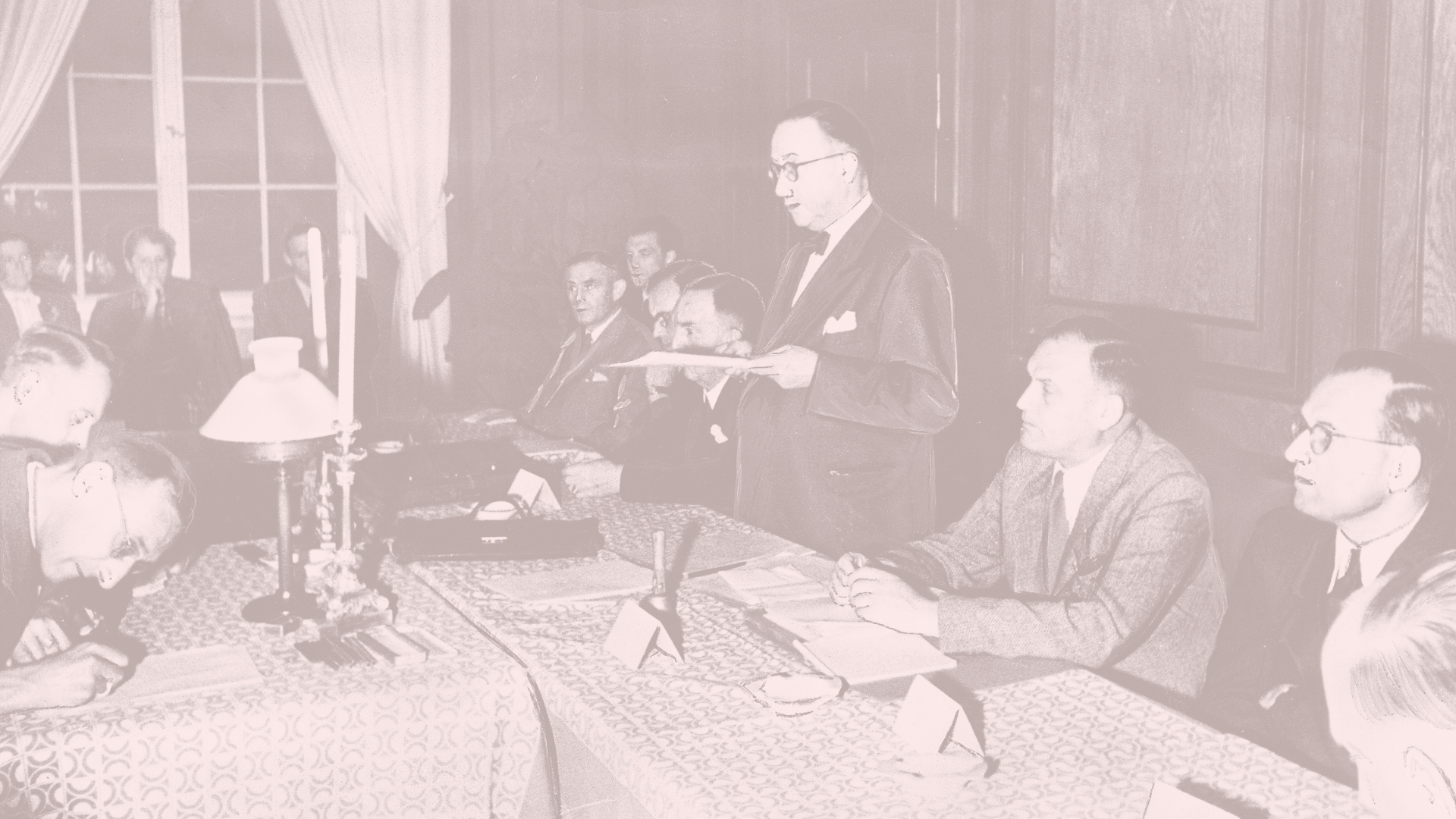
Das Bild zeigt die Teilnehmer des Verfassungskonvents von Herrenchiemsee. Der Verfassungsausschuss der Länder beginnt seine Arbeit im alten Schloss auf der Insel Herrenchiemsee. Als Vorsitzender eröffnet Dr. Anton Pfeiffer (CSU, 1888-1957) die Versammlung.
Object information
Type
Fotografie
Topic
Verfassungskonvent von Herrenchiemsee, Grundgesetz
Identifier
Bild-ID: 00008144
Participants, location and time information
Involved persons and organizations
Anton Pfeiffer
Time
10.08.1948
Location
Prien am Chiemsee
Further information
Informationen über die verwendeten Medien
Eröffnung des Verfassungskonvents von Herrenchiemsee
Dr. Anton Pfeiffer eröffnet die Versammlung
From the collection of
How can I use the object
Rights information
SZ Photo/Süddeutsche Zeitung Photo
Description
Das Bild zeigt die Teilnehmer des Verfassungskonvents von Herrenchiemsee. Der Verfassungsausschuss der Länder beginnt seine Arbeit im alten Schloss auf der Insel Herrenchiemsee. Als Vorsitzender eröffnet Dr. Anton Pfeiffer (CSU, 1888-1957) die Versammlung.
Object information
Type
Fotografie
Identifier
Bild-ID: 00008144
Participants, location and time information
Time
10.08.1948
Location
Prien am Chiemsee
Further information
Experts on an island
Between August 10 and 23, 1948, eleven delegates from the federal states and around 19 experts met at the Old Palace on the island of Herrenchiemsee to draft a new constitution for the Federal Republic of Germany. They had been given this task by the state premiers. The location, in the middle of Lake Chiemsee, had been chosen at the suggestion of Bavarian Premier Hans Ehard. The reason was its remoteness, which was intended to enable concentration on the work. The experts from academia and politics presented a draft constitution as the result.
A new constitution had become necessary because a new western state was to be formed from the three western occupation zones. After the Nazi dictatorship, a new foundation was needed for this—a new constitution.
Informationen über die verwendeten Medien
1.2 Bundesarchiv, Welt im Film (Originaltitel) Nr. 170 / 1948, Film: 41563
From the collection of
How can I use the object
Rights information
Bundesarchiv
Object information
Type
Nachrichtensendung
Topic
Verfassungskonvent von Herrenchiemsee
Part of
Welt im Film (Originaltitel)
Language
Deutsch
Identifier
Film: 41563
Participants, location and time information
Time
August 1948
Informationen über die verwendeten Medien
Die Verfassung des Deutschen Reiches vom 11. August 1919
Weimarer Verfassung, Zweite Auflage, Industrieverlag Spaeth & Linde
From the collection of
How can I use the object
Rights information
Universitäts- und Stadtbibliothek Köln
Object information
Type
Buch
Topic
Weimarer Reichsverfassung, Weimar, Verfassung
Material/Technique
Papier
Language
Originalsprache Deutsch
Identifier
DIRK830
Participants, location and time information
Involved persons and organizations
Dr. Georg Zöphel
Time
erschienen 1921
Location
Berlin
Role models?
During the negotiations at Herrenchiemsee, the experts drew on the first democratic constitution of 1849, the constitution of the Weimar Republic of 1919, and, above all, the state constitutions that emerged after 1945. The Weimar Constitution had formulated the following with regard to gender equality: “Men and women have fundamentally the same civil rights and duties.”
In this context, “fundamentally” meant an intentional restriction: the intention was to treat women formally as equal citizens with voting rights, but not to grant them equal rights in all other areas, such as working life and family.
Informationen über die verwendeten Medien
Friedrich Ebert bei seiner Eröffnungsrede in der Nationalversammlung
Die Nationalversammlung in Weimar. Volksbeauftrager Ebert hält die Eröffnungsrede
From the collection of
How can I use the object
Rights information
Deutsches Historisches Museum
Object information
Type
Fotografie
Topic
Weimarer Nationalversammlung, Weimar
Material/Technique
Fotopapier, s/w-Abzug
Identifier
Inventarnummer: F 55/641
Participants, location and time information
Involved persons and organizations
Friedrich Ebert
Time
06.02.1919
Location
Weimar
Informationen über die verwendeten Medien
1.3 Manuela Rienks: „staatsbürgerlich“ und „grundsätzlich“, AddF Kassel, 2025
From the collection of
How can I use the object
Rights information
Archiv der deutschen Frauenbewegung
Object information
Type
Interview
Topic
Gleichberechtigung, Grundgesetz
Language
Deutsch
Participants, location and time information
Time
2025
Location
Kassel
More than the Weimar Republic?
After only 13 days, the experts presented a report containing a first draft of the Basic Law. Interestingly, the draft was silent on the issue of equal rights. Unlike at the beginning of the Weimar Republic, when women's suffrage had been introduced and the state had to consider equality, a change now seemed unnecessary. Thus, the wording of the Weimar Constitution was once again on the table as a proposal. This meant that no change in gender relations was planned.
Informationen über die verwendeten Medien
Auszüge aus dem Bericht des Verfassungsausschusses der Ministerpräsidenten-Konferenz der westlichen Besatzungszonen über den Verfassungskonvent auf Herrenchiemsee vom 10. bis 23. August 1948
From the collection of
How can I use the object
Rights information
Archiv der deutschen Frauenbewegung
Description
Der Bericht erschien im Oktober 1948 und gibt die Ergebnisse der Beratungen von Herrenchiemsee wieder. Wesentlicher Teil des Berichts ist ein Grundrechtekatalog.
Object information
Type
Schriftgut, gedruckter Bericht
Topic
Verfassungskonvent auf Herrenchiemsee, Grundgesetz
Part of
Nachlass Elisabeth Selbert
Dimensions/Extent
10 Seiten / 5 Blatt
Material/Technique
Papier
Language
Deutsch
Identifier
NL-P-11 ; 00039M02/1
Participants, location and time information
Involved persons and organizations
Richard Pflaum Verlag
Time
1948
Location
München
No women on the Herreninsel
Informationen über die verwendeten Medien
1.4 Manuela Rienks: Keine Frauen auf der Herreninsel, AddF Kassel, 2025
From the collection of
How can I use the object
Rights information
Archiv der deutschen Frauenbewegung
Object information
Type
Interview
Topic
Gleichberechtigung, Grundgesetz
Language
Deutsch
Participants, location and time information
Time
2025
Location
Kassel
Informationen über die verwendeten Medien
Schreibmaschine
From the collection of
How can I use the object
Rights information
Bayerische Schlösserverwaltung/Manuela Rienks
Description
Mit einer vergleichbaren Schreibmaschine arbeiteten die beim Verfassungskonvent tätigen Frauen.
Object information
Type
Schreibmaschine
Topic
Prien am Chiemsee, Verfassungskonvent, Grundgesetz, Frauen beim Verfassungskonvent
Participants, location and time information
Time
1940/50
Informationen über die verwendeten Medien
Eröffnung des Verfassungskonvents von Herrenchiemsee
Dr. Anton Pfeiffer eröffnet die Versammlung
From the collection of
How can I use the object
Rights information
SZ Photo/Süddeutsche Zeitung Photo
Description
Das Bild zeigt die Teilnehmer des Verfassungskonvents von Herrenchiemsee. Der Verfassungsausschuss der Länder beginnt seine Arbeit im alten Schloss auf der Insel Herrenchiemsee. Als Vorsitzender eröffnet Dr. Anton Pfeiffer (CSU, 1888-1957) die Versammlung.
Object information
Type
Fotografie
Topic
Verfassungskonvent von Herrenchiemsee, Grundgesetz
Identifier
Bild-ID: 00008144
Participants, location and time information
Involved persons and organizations
Anton Pfeiffer
Time
10.08.1948
Location
Prien am Chiemsee
Further information
Think about it!
What if...
...women had also been present as experts at Herrenchiemsee?
Informationen über die verwendeten Medien
1.5 Manuela Rienks: Was wäre, wenn?, AddF Kassel, 2025
From the collection of
How can I use the object
Rights information
Archiv der deutschen Frauenbewegung
Object information
Type
Interview
Topic
Gleichberechtigung, Grundgesetz
Language
Deutsch
Participants, location and time information
Time
2025
Location
Kassel
Informationen über die verwendeten Medien
Elisabeth Selbert und Herta Gotthelf bei der SPD-Frauenkonferenz, Wuppertal 1948
From the collection of
How can I use the object
Rights information
Archiv der deutschen Frauenbewegung
Object information
Type
Fotografie
Topic
Wuppertaler Frauenkonferenz, Gleichberechtigung, Grundgesetz
Part of
Nachlass Elisabeth Selbert
Dimensions/Extent
8,7 x 12,7 cm
Identifier
A-F-NLP11-0075
Participants, location and time information
Involved persons and organizations
Elisabeth Selbert , Herta Gotthelf
Time
1948
Location
Wuppertal
Informationen über die verwendeten Medien
Festakt zur Eröffnung des Parlamentarischen Rats, Abgeordnete
From the collection of
Stiftung Haus der Geschichte der Bundesrepublik Deutschland
How can I use the object
Rights information
Stiftung Haus der Geschichte der Bundesrepublik Deutschland / Erna Wagner-Hehmke
Object information
Type
Fotografie
Topic
Parlamentarischer Rat, Grundgesetz, Festakt, Museum Alexander Koenig, SPD, FDP, CDU
Part of
Bestand Erna Wagner-Hehmke
Dimensions/Extent
6 x 6 cm
Material/Technique
Kunststoff
Identifier
1987/1/32.1459
Participants, location and time information
Involved persons and organizations
Carlo Schmid , Theodor Heuss , Erna Wagner-Hehmke
Time
01.09.1948
Location
Bonn
The work in Bonn begins
In order to develop a constitution for the later Federal Republic of Germany, the assembly had to be called in. This assembly was subsequently called “Parliamentary Council” and the to-be-developed constitution was referred to as “Basic Law”.
Eight committees worked within the Council, and their findings were discussed in the Main Committee. Equality was discussed in the Committee on Fundamental Issues.
Informationen über die verwendeten Medien
2.1 Bundesarchiv, Welt im Film (Originaltitel) Nr. 172 / 1948, Film: 50304
From the collection of
How can I use the object
Rights information
Bundesarchiv
Object information
Type
Nachrichtensendung
Topic
Parlamentarischer Rat, Gleichberechtigung, Grundgesetz
Part of
Welt im Film (Originaltitel)
Language
Deutsch
Identifier
Film: 50304
Participants, location and time information
Time
1948
Only “Fathers of the Constitution”?
The Parliamentary Council consisted of 61 male politicians and four female politicians with voting rights. They were not directly elected, but appointed by the existing state parliaments. Twenty-seven came from the CDU/CSU and the SPD, five from the FDP, and two each from the KPD, the German Party, and the Center Party.
Helene Weber represented the CDU, Helene Wessel represented the “Central Party”, which still existed at the time, and Frieda Nadig and Elisabeth Selbert were sent by the SPD.
Informationen über die verwendeten Medien
Zeitungsseite mit den Porträts der Mitglieder des Parlamentarischen Rates (aus "Die neue Zeitung")
Väter der Verfassung
From the collection of
Deutsches Historisches Museum
How can I use the object
Rights information
Deutsches Historisches Museum
Object information
Type
Druckschriften (Gattung)
Topic
Parlamentarischer Rat, Grundgesetz, Verfassung
Part of
Die Neue Zeitung
Dimensions/Extent
Höhe x Breite: 54,2 x 45,2 cm
Material/Technique
Papier, gedruckt
Language
Deutsch
Identifier
Do2 99/1684
Participants, location and time information
Involved persons and organizations
Elisabeth Selbert , Friederike Nadig , Helene Weber , Helene Wessel
Time
25.09.1948
Location
München
Informationen über die verwendeten Medien
2.2 Karin Gille-Linne: Frauen im Parlamentarischen Rat, AddF Kassel, 2025
From the collection of
How can I use the object
Rights information
Archiv der deutschen Frauenbewegung
Object information
Type
Interview
Language
Deutsch
Participants, location and time information
Time
2025
Location
Kassel
Informationen über die verwendeten Medien
Telegramm an Elisabeth Selbert
Telegramm an Elisabeth Selbert vom 19.09.1948 betreffend die Übermittlung eines Passfotos für eine Bilderseite mit den Mitgliedern des Parlamentarischen Rates
From the collection of
How can I use the object
Rights information
Archiv der deutschen Frauenbewegung
Object information
Type
Schriftgut, Telegramm
Topic
Gleichberechtigung, Parlamentarischer Rat
Part of
Nachlass Elisabeth Selbert
Dimensions/Extent
2 Seiten / 1 Blatt
Material/Technique
Papier
Language
Deutsch
Identifier
NL-P-11 ; 00039M04/1
Participants, location and time information
Involved persons and organizations
Elisabeth Selbert
Time
19.09.1948
Location
Bonn
A media event
The “Neue Zeitung” newspaper sent Elisabeth Selbert a telegram with an urgent request to send a portrait. It was to be used to introduce all members of the Parliamentary Council to the press. The telegram demonstrates the media's interest in the drafting of the constitution. To do this, they needed information and pictures of the women and men involved.
Informationen über die verwendeten Medien
AddF_NLP11_47-09_0005.jpg
Grundgesetz der Bundesrepublik Deutschland, beschlossen in Bonn am 08.05.1949
From the collection of
Archiv der deutschen Frauenbewegung
How can I use the object
Rights information
Archiv der deutschen Frauenbewegung
Object information
Type
Schriftgut
Topic
Gleichberechtigung, Grundgesetz, Parlamentarischer Rat
Part of
Nachlass Elisabeth Selbert
Material/Technique
Papier
Language
Deutsch
Identifier
NL-P-11 ; 00047M09
Participants, location and time information
Involved persons and organizations
Elisabeth Selbert
Time
1949
Equality at last?
The Parliamentary Council began its work on September 1, 1948, and adopted the Basic Law on May 8, 1949.
Article 3, paragraph 2 now stated: “Men and women have equal rights.”
How did this wording come about?
Informationen über die verwendeten Medien
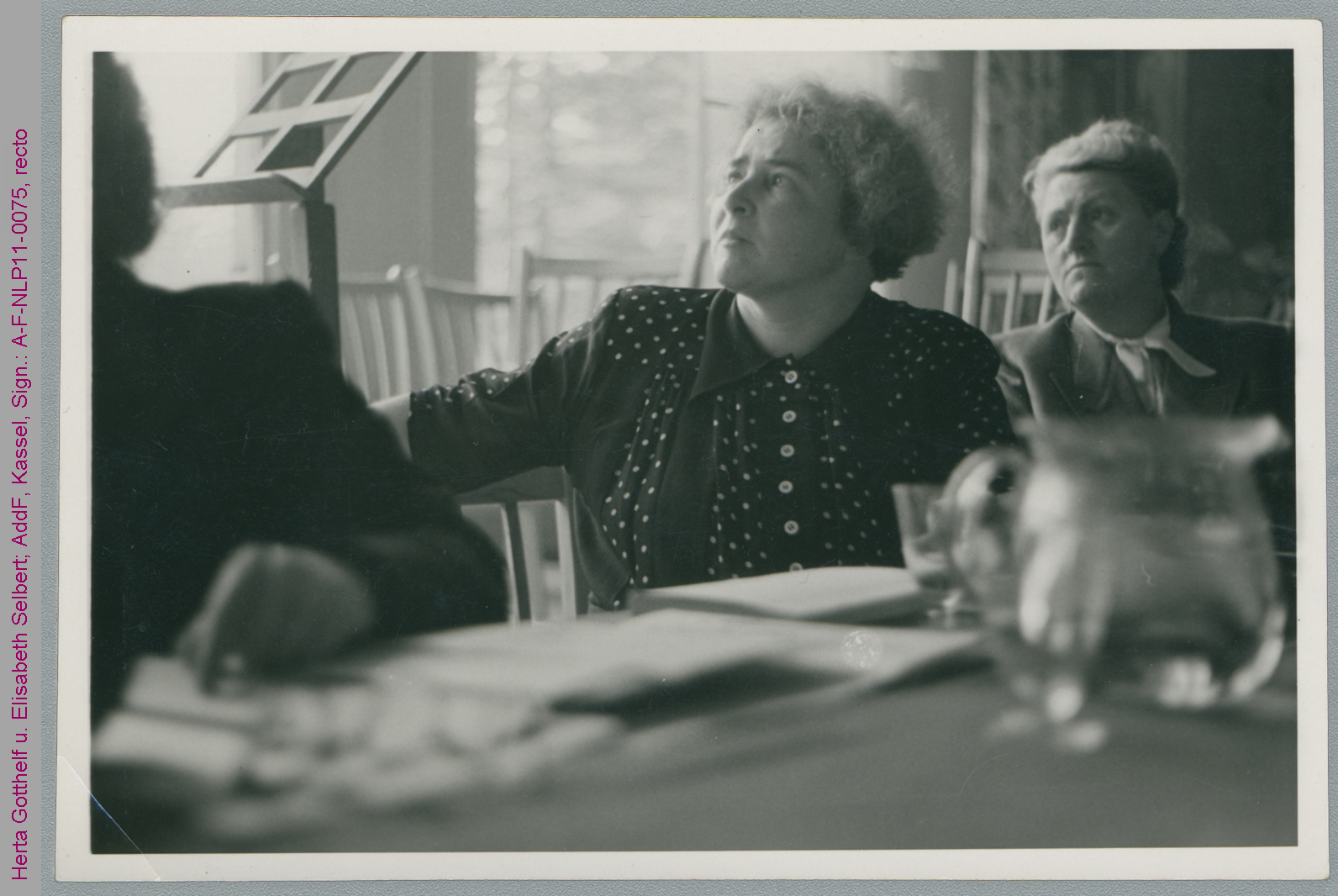
Elisabeth Selbert und Herta Gotthelf bei der SPD-Frauenkonferenz, Wuppertal 1948
From the collection of
How can I use the object
Rights information
Archiv der deutschen Frauenbewegung
Object information
Type
Fotografie
Topic
Wuppertaler Frauenkonferenz, Gleichberechtigung, Grundgesetz
Part of
Nachlass Elisabeth Selbert
Dimensions/Extent
8,7 x 12,7 cm
Identifier
A-F-NLP11-0075
Participants, location and time information
Involved persons and organizations
Elisabeth Selbert
Time
1948
Location
Wuppertal
We need a new phrasing!
This wording was mainly due to the female politicians within the SPD. They saw the drafting of a new constitution as an opportunity to fundamentally reform the patriarchal Civil Code of 1900. Experience with this law had shown that wives had been severely disadvantaged by the legislations of family law.
In order to discuss the demand for full equality for women in relation to the new constitution, SPD Women's Secretary Herta Gotthelf invited participants to a women's conference in Wuppertal. Lawyer Elisabeth Selbert gave the keynote speech and highlighted the problems that existed.
Informationen über die verwendeten Medien
Brief von Elisabeth Selbert an Herta Gotthelf
Brief von Elisabeth Selbert an Herta Gotthelf vom 08.11.1948 betreffend die Abgabe des Manuskriptes von einer Rede von Elisabeth Selbert in Wuppertal
From the collection of
How can I use the object
Rights information
Archiv der deutschen Frauenbewegung
Object information
Type
Schriftgut, Brief
Topic
Gleichberechtigung, SPD, Wuppertaler Frauenkonferenz
Part of
Nachlass Elisabeth Selbert
Dimensions/Extent
1 Seite / 1 Blatt
Language
Deutsch
Identifier
NL-P-11 ; 00020M03/1
Participants, location and time information
Involved persons and organizations
Herta Gotthelf , Elisabeth Selbert
Time
08.11.1948
Location
Hannover
How do you phrase equality?
But what exactly should the wording be? At the conference in Wuppertal, this had not yet been decided. Comrades from Berlin drew Herta Gotthelf's attention to the need for clear wording in the Basic Law. Gotthelf passed the task on to Elisabeth Selbert. At the SPD parliamentary group meeting, Selbert finally proposed the sentence: “Men and women are equal” and managed to get the party to include her proposal in the negotiations on the Basic Law. This exemplary wording was found in the SED's draft constitution for the GDR. It stated: “Men and women are equal.” This sentence was likely formulated by SED politician Käthe Kern.
Informationen über die verwendeten Medien
2.3 Karin Gille-Linne: Woher kommt die Formulierung?, AddF Kassel, 2025
From the collection of
How can I use the object
Rights information
Archiv der deutschen Frauenbewegung
Object information
Type
Interview
Language
Deutsch
Participants, location and time information
Time
2025
Location
Kassel
Wording found!
The proposal stated: “Men and women are equal.” With this simple sentence, the SPD parliamentary group joined the negotiations with the Committee on Fundamental Issues. It was Frieda Nadig in particular who championed this wording and explained why gender equality should be enshrined in the constitution. After a heated debate, the SPD parliamentary group's motion was rejected. The other parties feared legal chaos, as patriarchal family law would have to be completely revised because of the new formulation of equality.
Informationen über die verwendeten Medien
Antrag der SPD-Fraktion
Antrag der SPD-Fraktion zur Änderung des Art. 4 Abs. 2 in Männer und Frauen sind gleichberechtigt
From the collection of
How can I use the object
Rights information
Archiv der deutschen Frauenbewegung
Object information
Type
Schriftgut
Topic
Gleichberechtigung, Parlamentarischer Rat
Part of
Nachlass Elisabeth Selbert
Dimensions/Extent
2 Seiten / 1 Blatt
Material/Technique
Papier
Language
Deutsch
Identifier
NL-P-11 ; 00042M02/1
Participants, location and time information
Involved persons and organizations
SPD
Time
03.12.1948
Location
Bonn
Informationen über die verwendeten Medien
Sitzung Parlamentarischer Rat, Carlo Schmid, Elisabeth Selbert
From the collection of
How can I use the object
Rights information
Stiftung Haus der Geschichte der Bundesrepublik Deutschland / Erna Wagner-Hehmke
Object information
Type
Fotografie
Topic
Parlamentarischer Rat, Grundgesetz, Pädagogische Akademie, SPD Bonn; Schmid, Carlo; Selbert, Elisabeth; Wagner-Hehmke, Erna
Part of
Bestand Erna Wagner-Hehmke
Dimensions/Extent
6 x 6 cm
Material/Technique
Kunststoff
Identifier
1987/1/32.3735
Participants, location and time information
Involved persons and organizations
Carlo Schmid , Erna Wagner-Hehmke , Elisabeth Selbert
Time
1948 - 1949
Location
Bonn
Further information
Don’t give up!
However, the SPD, and Elisabeth Selbert in particular, did not give up. They put the same wording to the vote again in the main committee. Selbert defended the motion, arguing that a new era had dawned after the Second World War in which women had to be treated as equals, as they had long since ceased to be merely wives and mothers. SPD parliamentary group leader Carlo Schmid reinforced the motion in a subsequent speech.
Out of concern that the foundations of civil marriage could be jeopardized by equal rights, the other parties, except for the KPD, rejected the wording a second time.
Informationen über die verwendeten Medien
2.4 Karin Gille-Linne: Debatte im Hauptausschuss, AddF Kassel, 2025
From the collection of
How can I use the object
Rights information
Archiv der deutschen Frauenbewegung
Object information
Type
Interview
Language
Deutsch
Participants, location and time information
Time
2025
Location
Kassel
Ich kann bei dieser Gelegenheit erklären: In meinen kühnsten Träumen habe ich nicht erwartet, daß der Antrag im Grundsatzausschuß abgelehnt werden würde. Es ist eine Selbstverständlichkeit, daß man heute weiter gehen muß als in Weimar und daß man den Frauen die Gleichberechtigung auf allen Gebieten geben muß. Die Frau soll nicht nur in staatsbürgerlichen Dingen gleichstehen, sondern muß auf allen Rechtsgebieten dem Manne gleichgestellt werden.
Stellungnahme von Elisabeth Selbert (SPD) bei der ersten Lesung im Hauptausschuss am 3. Dez. 1948
Wenn durch die Schaffung der Gleichberechtigung der Frau gegenüber dem Mann in dem bisherigen Gesetz Lücken aufgerissen werden, müssen eben die bestehenden Gesetze modernisiert und den heutigen Forderungen der Frau auf Gleichberechtigung angeglichen werden. Das ist doch die einzige Konsequenz, die man meines Erachtens ziehen muß.
Stellungnahme von Heinz Renner (KPD) bei der ersten Lesung im Hauptausschuss am 3. Dez. 1948
Es ist selbstverständlich, daß auch wir grundsätzlich Ihren Antrag begrüßen. Wir dürfen aber darauf verweisen, daß die Durchführung (...) nicht so leicht sein wird, wie man sie sich denkt. (…) Welchen Namen führt zum Beispiel die Frau nach der Eheschließung, den des Mannes oder weiterhin ihren Familiennamen? Oder sollen, wenn Mann und Frau gleichberechtigt sind, Mann und Frau beide Namen führen? Welchen Familiennamen führen die Kinder, den Namen des Mannes oder den Namen der Frau oder beide? Wer hat während des Bestehens der Ehe die gesetzliche Gewalt über die minderjährigen Kinder, der Mann oder die Frau oder beide? Welche Meinung geht vor, wenn sie miteinander nicht übereinstimmen? Wird in jedem Falle erst das Vormundschaftsgericht gefragt oder was sonst?
Sie sehen, es sind in der praktischen Durchführung erhebliche Schwierigkeiten.
Stellungnahme von Max Becker (FDP) bei der ersten Lesung im Hauptausschuss am 3. Dez. 1948
Die Artikel, wie sie bis jetzt formuliert sind, führen genau zu dem, was Sie wollen, nämlich zu einer besseren Rechtsstellung der Frau. Wir halten es also nicht für notwendig, daß ein solcher Satz noch hereinkommt. Ich behalte mir eine weitere Stellungnahme bei der zweiten Lesung vor. Bis jetzt habe ich mich nicht davon überzeugen können.
Stellungnahme von Helene Weber (CDU/CSU) bei der ersten Lesung im Hauptausschuss am 3. Dez. 1948
Informationen über die verwendeten Medien
Parlamentarischer Rat, Sitzung des Hauptausschusses
From the collection of
How can I use the object
Rights information
Stiftung Haus der Geschichte der Bundesrepublik Deutschland / Erna Wagner-Hehmke
Object information
Type
Fotografie
Topic
Parlamentarischer Rat, Grundgesetz, Pädagogische Akademie, SPD, Bonn
Part of
Bestand Erna Wagner-Hehmke
Dimensions/Extent
6 x 6 cm
Material/Technique
Kunststoff
Identifier
1987/1/32.0131
Participants, location and time information
Involved persons and organizations
Erna Wagner-Hehmke
Time
23.02.1949
Location
Bonn
Further information
What now?
In her letter to Willi Eichler, comrade and editor-in-chief of the Rheinische Zeitung, Selbert requested immediate reporting on the failed vote in the council. She had already announced resistance in the event of rejection, which she now organized with the active support and logistical assistance of SPD women's secretary Herta Gotthelf and Frieda Nadig. They launched a very cleverly orchestrated campaign and attempted to provoke a public outcry. Time was short, as the rejection had taken place on December 3 and a further reading of the article was scheduled for January 18. In these six short weeks, Selbert and Gotthelf wrote countless letters, gave interviews to newspapers, and asked women's associations and individuals for support.
Informationen über die verwendeten Medien
Brief von Elisabeth Selbert an die Redaktion der Rheinischen Zeitung
Brief von Elisabeth Selbert vom 05.12.1948 an die Redaktion der Rheinischen Zeitung, betreffend die fehlende Berichterstattung über die Vorgänge im Hauptausschuss des Parlamentarischen Rates
From the collection of
How can I use the object
Rights information
Archiv der deutschen Frauenbewegung
Object information
Type
Schriftgut, Brief
Topic
Gleichberechtigung, Parlamentarischer Rat
Part of
Nachlass Elisabeth Selbert
Dimensions/Extent
1 Seite / 1 Blatt
Material/Technique
Papier
Language
Deutsch
Identifier
NL-P-11 ; 00046M03/1
Participants, location and time information
Involved persons and organizations
Elisabeth Selbert
Time
05.12.1948
Location
Bonn
Informationen über die verwendeten Medien
Zeitungsartikel: Bonn gegen gleiche Rechte der Frau?
Zeitungsartikel von Helene Weber, erschienen in die Welt am Sonntag vom 12.12.1948: Bonn gegen gleiche Rechte der Frau? Worum es bei der Abstimmung wirklich ging
From the collection of
How can I use the object
Rights information
Archiv der deutschen Frauenbewegung
Object information
Type
Schriftgut, Zeitungsartikel
Topic
Gleichberechtigung, Parlamentarischer Rat
Part of
Welt am Sonntag
Dimensions/Extent
2 Seiten / 1 Blatt
Material/Technique
Papier
Language
Deutsch
Identifier
NL-P-11 ; 00049M04/1
Participants, location and time information
Involved persons and organizations
Helene Weber
Time
12.12.1948
And what is the CDU up to?
The public debate surrounding the wording of gender equality led to a partial rethinking within the CDU/CSU parliamentary group. Helene Weber attempted to dispel the impression in newspaper articles that conservatives, and she herself, were opposed to women's equality. She repeatedly emphasized that there had been no differences of opinion on the content, but that it was a question of wording. To clarify her own position, she proposed the wording “men and women have the same rights and obligations.”
Informationen über die verwendeten Medien
Eingaben betreffend die Gleichberechtigung
Liste mit Institutionen und Vereinen, die eine Eingabe betreffend die Gleichberechtigung der Frauen eingereicht haben, zusammengestellt für Elisabeth Selbert
From the collection of
How can I use the object
Rights information
Archiv der deutschen Frauenbewegung
Object information
Type
Schriftgut, Auflistung
Topic
Gleichberechtigung, Parlamentarischer Rat
Part of
Nachlass Elisabeth Selbert
Dimensions/Extent
1 Seite / 1 Blatt
Material/Technique
Papier
Language
Deutsch
Identifier
NL-P-11 ; 00046M04/2
Participants, location and time information
Involved persons and organizations
Elisabeth Selbert
Time
1949
Location
Bonn
The crucial debate
When the main committee met again on January 18, 1949, everyone present was still reeling from the public debate. At this meeting, it became abundantly clear that the CDU/CSU parliamentary group did not want to leave gender equality solely up to the SPD and was therefore arguing for its own wording. However, Elisabeth Selbert was able to assert herself and her chosen wording.
Selbert used a list of submissions (from men and women) on the topic of equality as a template for her speech. Based on these submissions, she succeeded in convincing the council. This time, the main committee voted unanimously in favor of the wording: “Men and women are equal.”
We are all for it!
The campaign by Selbert and Gotthelf is considered to have played an important role in the acceptance of equal rights. However, closer examination reveals that not all submissions were in line with Selbert's views, even though they were written to support her. For example, the Munich Association for Women's Interests and Women's Work did not endorse Selbert's wording, but called for a sentence that was strongly based on the wording of the Weimar Constitution.
Informationen über die verwendeten Medien
Schreiben des Vereins für Fraueninteressen und Frauenarbeit e.V. an Elisabeth Selbert
Schreiben des Vereins für Fraueninteressen und Frauenarbeit e.V. vom 22.12.1948 an Elisabeth Selbert mit der Bitte um Berücksichtigung ihrer Position zu Artikel 4 des Grundgesetzes, dieser soll laut des Vereins folgendermaßen lauten: Männer und Frauen haben die gleichen staatsbürgerlichen und bürgerlich-rechtlichen Rechte und Pflichten
From the collection of
How can I use the object
Rights information
Archiv der deutschen Frauenbewegung
Object information
Type
Schriftgut, Brief
Topic
Gleichberechtigung, Parlamentarischer Rat
Part of
Nachlass Elisabeth Selbert
Dimensions/Extent
1 Seite / 1 Blatt
Material/Technique
Papier
Language
Deutsch
Identifier
AddF_NLP11_46-03-02_JPG
Participants, location and time information
Involved persons and organizations
Elisabeth Selbert
Time
22.12.1948
Location
München
Informationen über die verwendeten Medien
Parlamentarischer Rat, Sekretärin Frau Hofscheuer
Postfächer der Abgeordneten des Parlamentarischen Rates
From the collection of
How can I use the object
Rights information
Stiftung Haus der Geschichte der Bundesrepublik Deutschland / Erna Wagner-Hehmke
Object information
Type
Fotografie
Topic
Parlamentarischer Rat, Grundgesetz, Pädagogische Akademie, Verwaltung, Presse Bonn; Wagner-Hehmke, Erna
Part of
Bestand Erna Wagner-Hehmke
Dimensions/Extent
6 x 6 cm
Material/Technique
Kunststoff
Identifier
1987/1/32.3207
Participants, location and time information
Involved persons and organizations
Erna Wagner-Hehmke
Time
1948 - 1949
Location
Bonn
The Myth of the “Laundry Baskets”
And were there really “laundry baskets” full of submissions arriving at the Parliamentary Council? This narrative is very often accepted without question and this narrative is still being propagated on radio and television today. However, research has shown that there were far fewer. Probably around 50 in total.
Selbert used these submissions very skillfully to position herself and her party for the first federal election. The SPD was to be seen as the party of equality and consequently be voted for by many women.
Informationen über die verwendeten Medien
2.5 Karin Gille-Linne: „Waschkörbe“, AddF Kassel, 2025
From the collection of
How can I use the object
Rights information
Archiv der deutschen Frauenbewegung
Object information
Type
Interview
Language
Deutsch
Participants, location and time information
Time
2025
Location
Kassel
der gestrige Tag, an dem die Gleichberechtigung der Frau in die Verfassung aufgenommen worden ist, dieser Tag war ein geschichtlicher Tag.
Elisabeth Selbert in ihrer Ansprache im Nordwestdeutschen Rundfunk am 19. Januar 1949
Informationen über die verwendeten Medien
rede-selbert_vom-19.1.1949.mp3
From the collection of
How can I use the object
Rights information
Archiv der deutschen Frauenbewegung
Object information
Type
Rundfunkansprache
Topic
Gleichberechtigung, Grundgesetz, Parlamentarischer Rat
Language
Deutsch
Participants, location and time information
Involved persons and organizations
Elisabeth Selbert
Time
1949
Informationen über die verwendeten Medien
Elisabeth Selbert und Herta Gotthelf bei der SPD-Frauenkonferenz, Wuppertal 1948
From the collection of
How can I use the object
Rights information
Archiv der deutschen Frauenbewegung
Object information
Type
Fotografie
Topic
Wuppertaler Frauenkonferenz, Gleichberechtigung, Grundgesetz
Part of
Nachlass Elisabeth Selbert
Dimensions/Extent
8,7 x 12,7 cm
Identifier
A-F-NLP11-0075
Participants, location and time information
Involved persons and organizations
Elisabeth Selbert , Herta Gotthelf
Time
1948
Location
Wuppertal
Think about it!
What if......
no one in the Parliamentary Council had advocated for equal rights?...
the SPD had not received support from society?
Informationen über die verwendeten Medien
2.6 Karin Gille-Linne: Was wäre, wenn?, AddF Kassel, 2025
From the collection of
How can I use the object
Object information
Type
Interview
Language
Deutsch
Participants, location and time information
Time
2025
Location
Kassel
Informationen über die verwendeten Medien
Beschluss des Bundesverfassungsgerichts
Beschluss des Bundesverfassungsgerichts, dass sein Gutachten über die Vereinbarkeit des EVG-Vertrags und des Generalvertrags mit dem Grundgesetz die beiden Senate in allen weiteren Entscheidungen bindet.
From the collection of
How can I use the object
Rights information
Stadtarchiv Karlsruhe 8/BA Schlesiger A5/113/1/34a
Description
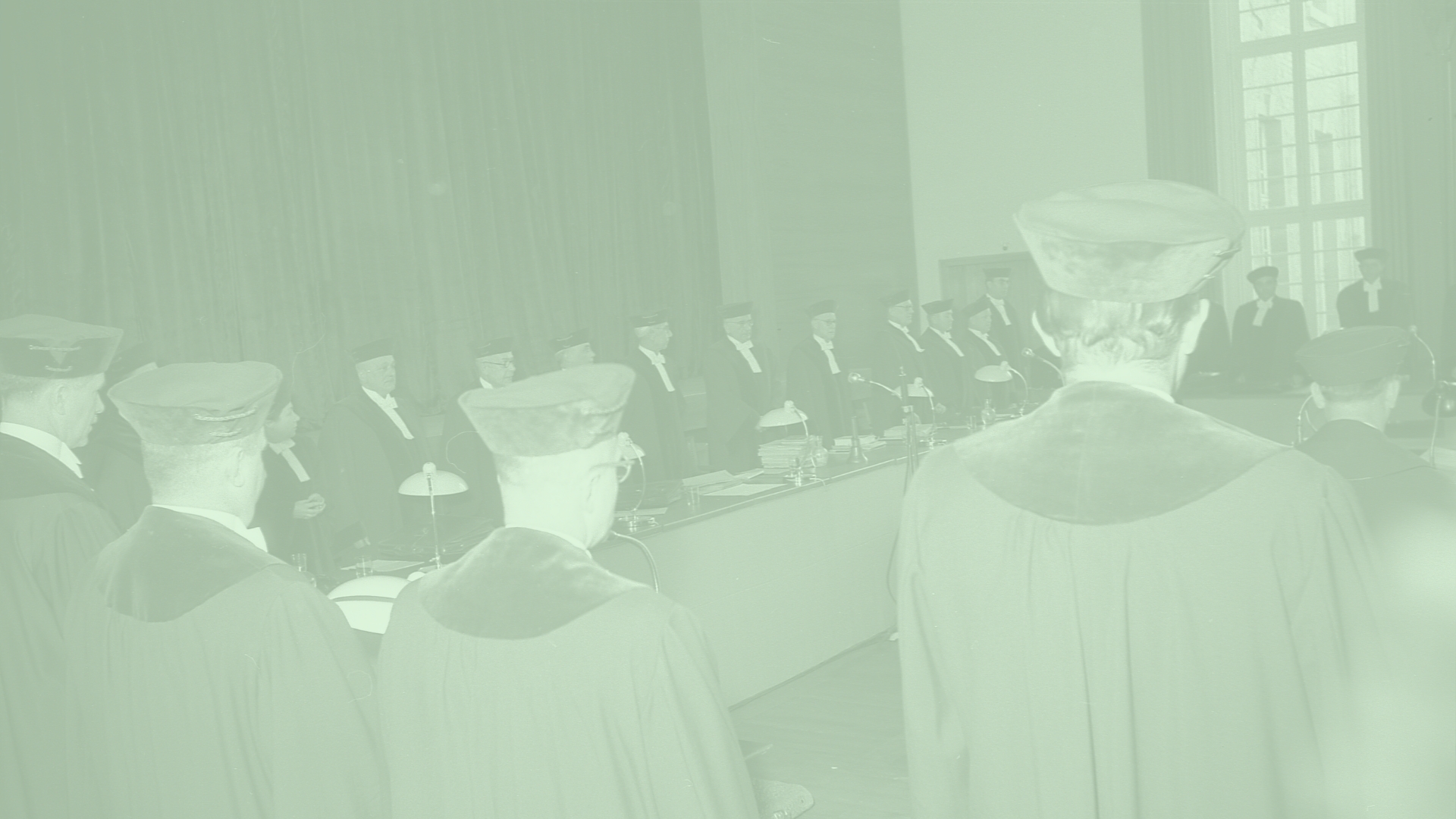
Blick in den Saal des Studentenhauses (verwendet wegen Raummangel im Prinz-Max-Palais) nach dem Einzug der 23 Richter*innen. Die Richterin und die Richter stehend von links nach rechts: Dr. Erna Scheffler, Ellinghaus, Bernhard Wolff, Vizepräsident Dr. Katz, Präsident Dr. Höpker-Aschoff, Dr. Georg Fröhlich, Dr. Conrad Rödiger, Dr. Schunk, Dr. Gerhard Heiland, Dr. Alfred Henneka, Dr. Leibholz.
Object information
Type
Fotografie
Topic
Prinz-Max-Palais, Bundesverfassungsgericht
Part of
Bildarchiv Schlesiger 1949-1952
Dimensions/Extent
Negativ: 24 x 36 mm, Positiv: 8 x 14 cm
Identifier
8/BA Schlesiger 1949-1952
Participants, location and time information
Involved persons and organizations
Horst Schlesiger , Lilo Schlesiger
Time
10.12.1952
Location
Karlsruhe
Informationen über die verwendeten Medien
Wahlplakat der CDU zur Bundestagswahl, 1949
From the collection of
How can I use the object
Rights information
Archiv der Konrad-Adenauer-Stiftung: KAS / ACDP, 10-001-18.
Changing family law!
After the end of the Parliamentary Council, one thing was clear: equality was enshrined in the Basic Law. However, to implement it, the first federal government had to amend family law. The deadline set for this in the Basic Law was March 31, 1953.
Before the first federal election in 1949, all parties campaigned for women's votes, as more women than men were eligible to vote. The issue of “equality” was addressed more or less explicitly. Ultimately, the CDU/CSU won the election. Together with the FDP and DP (German Party), it formed the first West German coalition government under Chancellor Konrad Adenauer.
And what is the Federal Government up to?
Minister of Justice Thomas Dehler (FDP) was responsible for the issue of equal rights and new family law in the new Bundestag. But while the KPD and SPD pushed to initiate the amendment process as quickly as possible, the governing coalition took its time.
First, Dehler commissioned Maria Hagemeyer to write a memorandum in early 1950. In the document, published in 1951, she compiled the provisions that would need to be amended in family law in order to bring it into line with the principle of equal rights. Hagemeyer had been the first female judge in the Weimar Republic and was now head of the “Equal Rights for Men and Women” department at the Ministry of Justice.
Informationen über die verwendeten Medien
Rundschreiben des Bundesministers der Justiz
Rundschreiben des Bundesministers der Justiz betreffend die Durchführung des Artikel 3 Absatz 2 des Grundgesetzes auf dem Gebiete des Privatrechts
From the collection of
How can I use the object
Rights information
Archiv der deutschen Frauenbewegung
Object information
Type
Schriftgut, Brief
Topic
Gleichberechtigung, Familienrecht, Privatrecht
Part of
Bestand Evangelische Frauenarbeit in Deutschland
Dimensions/Extent
2 Seiten / 1 Blatt
Language
Deutsch
Identifier
NL-K-33 ; 214-1/2
Participants, location and time information
Involved persons and organizations
Thomas Dehler , Dr. Maria Hagemeyer
Time
01.03.1951
Location
Bonn
Informationen über die verwendeten Medien
Denkschrift von Dr. Maria Hagemeyer über die Anpassung des Familienrechts
Denkschrift über die zur Anpassung des geltenden Familienrechts an den Grundsatz der Gleichberechtigung von Mann und Frau, Art. 3 Abs. 2 GG, erforderlichen Gesetzesänderungen, Teil I., ausgearbeitet von Oberlandesgerichtsrätin Dr. Hagemeyer
From the collection of
How can I use the object
Rights information
Archiv der deutschen Frauenbewegung
Object information
Type
Schriftgut, Denkschrift
Topic
Familienrecht, Gleichberechtigung, Grundgesetz
Part of
Bestand Deutscher Evangelischer Frauenbund
Dimensions/Extent
28 Seiten / 7 Blatt
Language
Deutsch
Identifier
NL-K-16 ; H-456/1
Participants, location and time information
Involved persons and organizations
Dr. Maria Hagemeyer
Time
1951
What is stated in the memorandum?
Hagemeyer first addressed general issues concerning the relationship between spouses, then matrimonial property law, and finally the legal relationship between parents and children. According to her recommendations, both spouses should have equal rights of co-determination when it comes to decisions concerning marriage and child-rearing. In the event of conflict, spouses should turn to counseling centers outside the family. Nevertheless, her draft still provided for restrictions on wives working outside the home. Regarding matrimonial property law, she agreed with the reform efforts that the women's movement had already expressed during the Weimar Republic.
Informationen über die verwendeten Medien
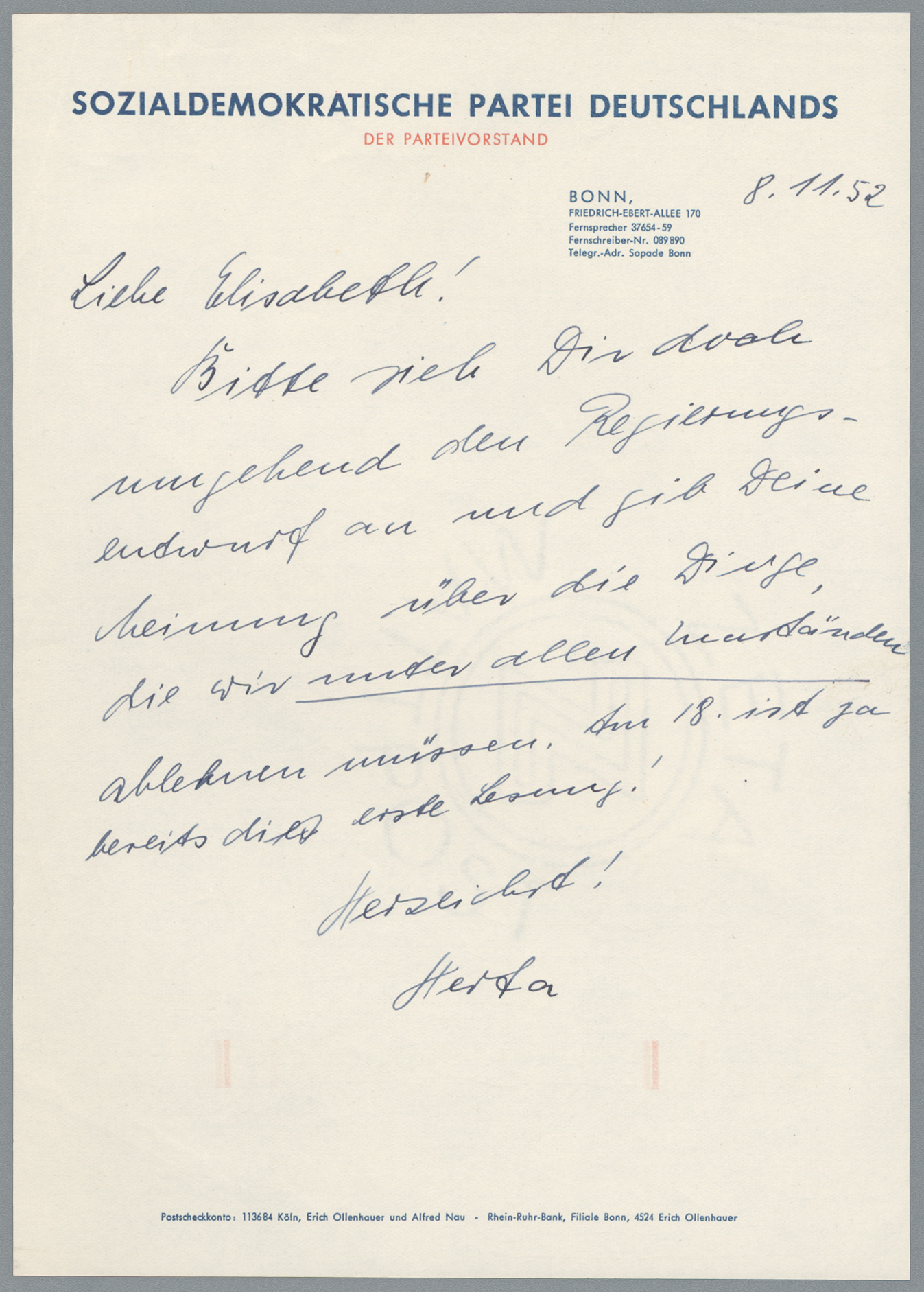
Brief von Herta Gotthelf an Elisabeth Selbert
Brief von Herta Gotthelf an Elisabeth Selbert vom 08.11.1952 betreffend Selberts Meinung zu einem Regierungsentwurf
From the collection of
How can I use the object
Rights information
Archiv der deutschen Frauenbewegung
Object information
Type
Schriftgut, Brief
Topic
Gleichberechtigung, Familienrecht
Part of
Nachlass Elisabeth Selbert
Dimensions/Extent
2 Seiten / 1 Blatt
Material/Technique
Papier
Language
Deutsch
Identifier
NL-P-11 ; 00024M03/4
Participants, location and time information
Involved persons and organizations
Herta Gotthelf , Elisabeth Selbert
Time
08.11.1952
Location
Bonn
A first draft – and lots of criticism
Three years after the federal elections, on October 23, 1952, the federal government finally presented its first draft bill. The opposition, especially the SPD, sharply criticized it. Herta Gotthelf coordinated her position on this issue with Elisabeth Selbert. Although Selbert herself was not a member of the Bundestag, she remained an expert on family law within the SPD.
After the first reading in the Bundestag, the bill was to be further processed by a committee. It became clear that this approach would prevent the federal government from meeting the March 31, 1953 deadline.
Casting votes are crucial!
Another major problem was the so-called “tie-breaking decisions.” These concerned the right of the father and husband to make decisions alone, without the wife and mother, in cases of conflict. In her statement on the first draft of a new family law, for example, SPD politician and lawyer Charlotte Walner-von Deuten highlighted the “core problems” of the discussion.
The parties' opinions on whether these should be deleted or maintained varied widely.
Informationen über die verwendeten Medien
Stellungnahme zum Entwurf eines Gesetzes über die Gleichberechtigung
Stellungnahme von Charlotte Walner-von Deuten zum Entwurf eines Gesetzes über die Gleichberechtigung von Mann und Frau auf dem Gebiete des bürgerlichen Rechts und über die Wiederherstellung der Rechtseinheit auf dem Gebiete des Familienrechts
From the collection of
How can I use the object
Rights information
Archiv der deutschen Frauenbewegung
Object information
Type
Schriftgut, Formale Stellungnahme
Topic
Gleichberechtigung, Grundgesetz, Familienrechtsreform
Part of
Nachlass Elisabeth Selbert
Dimensions/Extent
10 Seiten / 5 Blatt
Material/Technique
Papier
Language
Deutsch
Identifier
NL-P-11 ; 00024M03/2
Participants, location and time information
Involved persons and organizations
Charlotte Walner-von Deuten
Time
1952
Informationen über die verwendeten Medien
3.1 Eva Balz: Stichentscheide, AddF Kassel, 2025
From the collection of
How can I use the object
Rights information
Archiv der deutschen Frauenbewegung
Object information
Type
Interview
Language
Deutsch
Participants, location and time information
Time
2025
Location
Kassel
Informationen über die verwendeten Medien
AddF-F-NLP11-0083_Kopie.jpg
From the collection of
How can I use the object
Rights information
Archiv der deutschen Frauenbewegung
Object information
Type
Fotografie
Topic
SPD
Part of
Nachlass Elisabeth Selbert
Dimensions/Extent
11,9 x 18,1 cm
Identifier
A-F-NLP11-0083
Participants, location and time information
Involved persons and organizations
Elisabeth Selbert
Time
1951 - 1952
Location
Bonn
Time is running out
In view of the expiring deadline, the federal government proposed an extension. Since this involved an amendment to the Basic Law (Art. 117, para. 1), it needed a two-thirds majority in the Bundestag. The federal government rejected a proposal by the SPD to speed up the process to meet the deadline. The SPD then opposed the extension. It accused the government of deliberate delay and feared that the deadline would be postponed further.
As a result of the inaction, the deadline expired.
Seit dem Ablauf der in Art. 117 Abs. 1 zweiter Halbsatz GG gesetzten Frist sind Mann und Frau auch im Bereich von Ehe und Familie gleichberechtigt.
Auszug aus dem Urteil des Bundesverfassungsgerichtes vom 18. Dez. 1953 zu Art. 3 und Art. 117 GG
Statement on the ruling of the Federal Constitutional Court
The ruling of the Federal Constitutional Court meant that Article 3(2) of the Basic Law now also applied to family law. Nevertheless, family law still had to be revised. This was because the old family law was unconstitutional; it contradicted the principle of equal rights that stated men and women are equal.
The second attempt
In 1953, new elections were held for the Bundestag. The re-elected Chancellor Konrad Adenauer now led a coalition consisting of the CDU/CSU, FDP, DP, and the Alliance of Expellees and Disenfranchised Persons (BHE). The election also brought about changes in the distribution of responsibilities within the federal government. Minister of Justice Fritz Neumayer (FDP) formally continued Dehler's work, but showed little interest in the subject of family law. The Ministry for Family Affairs was newly created under Franz-Josef Wuermeling. He actively participated in the debate, representing a conservative point of view.
Informationen über die verwendeten Medien
3.2 Bundesarchiv, Neue Deutsche Wochenschau (Originaltitel), Nr. 195 / 1953
From the collection of
How can I use the object
Rights information
Bundesarchiv
Object information
Type
Nachrichtensendung
Part of
Neue Deutsche Wochenschau (Originaltitel)
Language
Deutsch
Participants, location and time information
Time
1953
Informationen über die verwendeten Medien
§-zeichen.png
From the collection of
Archiv der deutschen Frauenbewegung
How can I use the object
Endurance is needed
Nonetheless, everything only got going one and a half years after the election. In February 1955, the subcommittee “Family Law Act” was formed. 17 parliamentarians, including six (!) women, from five parties deliberated upon a new Family Law. These consultations/deliberations took 77 sessions which ultimately lasted longer than two years. Especially the casting votes were controversial. In close votes, the members ultimately decided against the husband's casting vote. The father's casting vote, on the other hand, remained in the committee's draft.
Informationen über die verwendeten Medien
3.3 Eva Balz: Parteien und Gleichberechtigung, AddF Kassel, 2025
From the collection of
How can I use the object
Rights information
Archiv der deutschen Frauenbewegung
Object information
Type
Interview
Language
Deutsch
Participants, location and time information
Time
2025
Location
Kassel
Now it’s time to decide!
On May 3, 1957, eight years after the enacting of the Basic Law, the Federal Parliament held another lively debate about the new Family Law. The basis for this debate was the draft legislation which was related to the results of the subcommittee “Family Law”.
The CDU tried to re-enshrine the husband’s casting vote with a motion. The CDU’s motion failed. At the same time, the SPD, FDP, and a group of CDU/CSU members of parliament proposed the abolition of the father's casting vote. Elisabeth Schwarzhaupt took the lead in the CDU, speaking out against the majority opinion of her party. This proposal also failed. The father's casting vote remained, while the husband's casting vote was abolished. The Bundestag passed the new law, which came into effect in July 1958.
Informationen über die verwendeten Medien
Entwurf eines Gesetzes über die Gleichberechtigung...
Deckblatt des Entwurfs eines Gesetzes über die Gleichberechtigung von Mann und Frau auf dem Gebiete des bürgerlichen Rechts und über die Wiederherstellung der Rechtseinheit auf dem Gebiete des Familienrechts
From the collection of
How can I use the object
Rights information
Archiv der deutschen Frauenbewegung
Object information
Type
Schriftgut, Gesetzesentwurf
Topic
Gleichberechtigung, Familienrecht
Dimensions/Extent
4 Seiten / 1 Blatt
Language
Deutsch
Identifier
NL-P-11 ; 00024M03/1
Participants, location and time information
Time
1952
Nein, Herr Kollege! Sie sagen also hier ganz zugespitzt: Sie verneinen, daß die durch Artikel 6 geschützte Familie [Hervorhebung i. O.] eine auf dem Prinzip der Gleichberechtigung [Hervorhebung i. O.] beruhende Familie ist. Wir halten das für eine sehr bemerkenswerte Feststellung, die Sie da machen. Aber wir glauben – ich habe das hier bereits zum Ausdruck gebracht, und sowohl aus der Verfassungsgeschichte der deutschen Republik wie auch aus unserer Verfassungsordnung und natürlich auch aus unserer Lebensordnung, wie ich zuvor angeführt habe, folgern zu müssen, daß die geschützte Ehe und die geschützte Familie die auf dem Prinzip der Gleichberechtigung beruhende Ehe ist.
Karl Wittrock (SPD) während der Debatte in der 2. Lesung am 3. Mai 1957
Wenn ich gegen den Letztentscheid des Mannes [Hervorhebung i. O.] in allen ehelichen Angelegenheiten bin, so keineswegs deshalb, weil ich etwa in diejenigen Familien, in denen ihr Verständnis christlicher Traditionen diese Verordnung des Mannes bejaht, eingreifen wollte. Keineswegs! Dieses soll unangetastet bleiben, weil es aus einer Ordnung kommt, die viel tiefer begründet ist, als das staatliche Recht, aus einer Ordnung, die dem staatlichen Recht vorgegeben ist, die aber nicht durch staatliches Recht gestaltet werden kann.
Elisabeth Schwarzhaupt (CDU/CSU) während der Debatte in der 2. Lesung am 3. Mai 1957
Auch in gesunden, normalen Ehen kann man sich manchmal nicht einigen, und da muß irgendwie entschieden werden auch in bezug [sic] auf das, was zur Lebensform der beiden Ehegatten gehört. Da wollen wir – Stichentscheid ist ein schlechtes Wort; Letztentscheid gefällt mir auch nicht –, daß einer von beiden entscheidet, und da sagen wir, es möge der Mann entscheiden.
Helene Weber (CDU/CSU) während der Debatte in der 2. Lesung am 3. Mai 1957
Meine verehrten Kollegen! Wenn hier ein reines Übergewicht des Mannes wie bisher bestehenbleibt, so kann gar kein Zweifel daran sein, daß in zahllosen Fällen die Autorität der Mutter [Hervorhebung i. O.] in den Augen der Kinder erheblich Schaden leiden muß. Wollen wir das? Ich glaube, das wollen wir nicht. Wir sind vielmehr der Meinung, daß man alles tun sollte, um die Autorität der Mutter zu stärken.
Marie-Elisabeth Lüders (FDP) während der Debatte in der 2. Lesung am 3. Mai 1957
Ich bitte Sie noch einmal, unserem gemeinsamen Anliegen zu entsprechen (…). Begnügen Sie sich nicht mit einer Klage über den Verlust der patriarchalischen Verhältnisse, über die Zunahme der Ehekrisen, über das Absinken des Verantwortungsgefühls, sondern tun Sie mutig einen Schritt in die Zukunft und helfen Sie dazu, daß die Verantwortung in der Familie, die Erhaltung der Familie, aber auch die ausgleichende Stimme der Frau in der Familie zur Befriedung beiträgt und führt.
Margot Kalinke (DP [FVP]) während der Debatte in der 2. Lesung am 3. Mai 1957
Die sozialdemokratische Bundestagsfraktion bedauert es außerordentlich, daß entgegen der Verfassung der Stichentscheid des Vaters beschlossen worden ist. Das macht es uns schwer, dem Gesetz im ganzen [sic!] zuzustimmen. Aber wir sind davon überzeugt, daß diese verfassungswidrige Bestimmung fallen wird und fallen muß. Das Gesetz enthält im übrigen so viel Dringliches, Wichtiges und Fortschrittliches, daß wir trotz dieses Fehlers – nicht Schönheitsfehlers – dem Gesetz im ganzen [sic!] zustimmen werden.
Ludwig Metzger (SPD) nach der Abstimmung am 3. Mai 1957
It’s not over yet
One year later, on July 30, 1959, the Frankfurter Allgemeine Zeitung ran the headline: “Father and mother should decide together.” In the end, the father's casting vote had been cast. What had happened?
Informationen über die verwendeten Medien
3.4 Eva Balz: Die Entscheidung des Bundesverfassungsgerichtes, AddF Kassel, 2025
From the collection of
How can I use the object
Rights information
Archiv der deutschen Frauenbewegung
Object information
Type
Interview
Topic
Gleichberechtigung, Grundgesetz
Language
Deutsch
Participants, location and time information
Time
2025
Location
Kassel
Informationen über die verwendeten Medien
Beschluss des Bundesverfassungsgerichts
Beschluss des Bundesverfassungsgerichts, dass sein Gutachten über die Vereinbarkeit des EVG-Vertrags und des Generalvertrags mit dem Grundgesetz die beiden Senate in allen weiteren Entscheidungen bindet.
From the collection of
How can I use the object
Rights information
Stadtarchiv Karlsruhe
Description
Blick in den Saal des Studentenhauses (verwendet wegen Raummangel im Prinz-Max-Palais) nach dem Einzug der 23 Richter*innen. Die Richterin und die Richter stehend von links nach rechts: Dr. Erna Scheffler, Ellinghaus, Bernhard Wolff, Vizepräsident Dr. Katz, Präsident Dr. Höpker-Aschoff, Dr. Georg Fröhlich, Dr. Conrad Rödiger, Dr. Schunk, Dr. Gerhard Heiland, Dr. Alfred Henneka, Dr. Leibholz.
Object information
Type
Fotografie
Topic
Prinz-Max-Palais - Bundesverfassungsgericht Einzug der 23 Richter
Part of
Bildarchiv Schlesiger 1949-1952
Dimensions/Extent
Negativ: 24 x 36 mm, Positiv: 8 x 14 cm
Identifier
8/BA Schlesiger 1949-1952
Participants, location and time information
Involved persons and organizations
Horst Schlesiger , Lilo Schlesiger
Time
10.12.1952
Location
Karlsruhe
Informationen über die verwendeten Medien
Entschließung Nr. 1 des Frauenbezirksausschusses
Entschließung Nr. 1 des Frauenbezirksausschusses des DGB gegen eine Terminverschiebung für das Wirksamwerden der Familienrechtsreform
From the collection of
How can I use the object
Rights information
Archiv der deutschen Frauenbewegung
Object information
Type
Schriftgut, Informationsbroschüre
Topic
Gleichberechtigung, Grundgesetz, Familienrechtsreform
Part of
Nachlass Elisabeth Selbert
Dimensions/Extent
2 Seiten / 1 Blatt
Material/Technique
Papier
Language
Deutsch
Identifier
NL-P-11 ; 00024M03/3
Participants, location and time information
Involved persons and organizations
Frauenbezirksausschuss des DGB
Time
1952
Location
Hessen
That took a while…
Equality in discussion
The debate on the adaptation of family law to the principle of equal rights was not limited to parliament. Even during the development of the first government draft, the Ministry of Justice sought advice from experts from churches and associations.
Throughout the entire period, there were statements made and protests voiced from political parties, churches, trade unions, women's associations, and private individuals. The topic of equality was also discussed in the media. Petitions expressing at least part of the populations’ concern regarding the topic were submitted to the Bundestag.
Informationen über die verwendeten Medien
Zeitungsartikel: Gleichberechtigung von Mann und Frau
Zeitungsartikel vom 16.09.1950: Gleichberechtigung von Mann und Frau. Am 14. September beginnt in Frankfurt der Deutsche Juristentag
From the collection of
How can I use the object
Rights information
Archiv der deutschen Frauenbewegung
Object information
Type
Zeitungsartikel
Topic
Gleichberechtigung, Juristentag
Part of
Hessische Nachrichten
Dimensions/Extent
2 Seiten / 1 Blatt
Material/Technique
Zeitungspapier
Language
Deutsch
Identifier
NL-P-11 ; 00029M08/1
Participants, location and time information
Time
13.9.1950
The male and female lawyers also discussed the issue
In the fall of 1950, male and female lawyers discussed, for example, the necessary adjustments to family law in line with the principle of equal rights at the 38th German Lawyers' Conference. In her keynote speech, Judge Erna Scheffler clearly advocated for the abolition of both casting votes.
Public Speaking
The topic was also discussed at public events. Elisabeth Selbert continued to be an expert for Family Law and the Equality Principle in the SPD.
Informationen über die verwendeten Medien
Plakat für eine öffentliche Frauenversammlung mit einem Vortrag von Elisabeth Selbert
From the collection of
Archiv der deutschen Frauenbewegung
How can I use the object
Rights information
Archiv der deutschen Frauenbewegung
Object information
Type
Schriftgut, Plakat
Topic
Gleichberechtigung, Grundgesetz
Part of
Nachlass Elisabeth Selbert
Dimensions/Extent
33,4 x 42,5 cm
Material/Technique
Papier
Language
Deutsch
Identifier
NL-P-11 ; 00100M12/1
Participants, location and time information
Involved persons and organizations
Elisabeth Selbert
Time
26.06.1952
Location
Frankfurt
Informationen über die verwendeten Medien
Brief von Elisabeth Schwarzhaupt an Hildegard Krüger
Brief von Dr. Elisabeth Schwarzhaupt an Hildegard Krüger vom 13.05.1952 betreffend eine Stellungnahme der Evangelischen Kirche
From the collection of
How can I use the object
Rights information
Archiv der deutschen Frauenbewegung
Object information
Type
Schriftgut, Brief
Topic
Familienrecht, evangelische Kirche
Part of
Bestand Evangelische Frauenarbeit in Deutschland
Dimensions/Extent
2 Seiten / 1 Blatt
Language
Deutsch
Identifier
NL-K-33 ; 214-1/1
Participants, location and time information
Involved persons and organizations
Elisabeth Schwarzhaupt , Hildegard Krüger
Time
13.05.1952
Location
Frankfurt am Main
The churches are also involved in the discussion
The Catholic and Protestant churches showed particular interest in the issue. However, their positions differed greatly.
The Catholics voted unanimously to retain both casting votes. The Protestant Church proposed abolishing the husband's casting vote while retaining the father's right of decision.
The Protestant Women's Association, led by Elisabeth Schwarzhaupt, senior church councilor and later CDU member of parliament, protested against both casting votes. Schwarzhaupt also conveyed this position to the judge and author Hildegard Krüger, who was critical of family law.
The press reports
In the debate, Family Minister Wuermeling based his views on a traditional Christian model of the family. In September 1954, Der Spiegel asked Wuermerling what he perceives as the ideal family model. The paper later published a critical analysis of the family minister's position.
Informationen über die verwendeten Medien
Der Spiegel, Cover mit Porträt von Franz-Josef Wuermeling
From the collection of
How can I use the object
Rights information
DER SPIEGEL 38/1954
Object information
Part of
DER SPIEGEL 38/1954
Language
Deutsch
Participants, location and time information
Involved persons and organizations
Franz-Josef Wuermeling
Time
15.09.1954
Location
Hamburg
Further information
Parties with their own ideas
Even beyond the governing coalition, family law was the subject of lively debates within the parties. The FDP and SPD each presented their own draft bills/legislations during the second legislative period. The SPD set up a special subcommittee for this purpose, which also included Elisabeth Selbert as an expert.
Informationen über die verwendeten Medien
Telegramm an Elisabeth Selbert
Telegramm an Elisabeth Selbert betreffend die Sitzung des rechtspolitischen Ausschusses zum Thema Gleichberechtigung
From the collection of
How can I use the object
Rights information
Archiv der deutschen Frauenbewegung
Object information
Type
Telegramm
Topic
Gleichberechtigung, Familienrecht, SPD
Part of
Nachlass Elisabeth Selbert
Dimensions/Extent
2 Seiten / 1 Blatt
Material/Technique
Papier
Language
Deutsch
Identifier
NL-P-11 ; 00024M04/1
Participants, location and time information
Involved persons and organizations
Elisabeth Selbert , Herta Gotthelf
Time
1953
Location
Kassel
Informationen über die verwendeten Medien
Beschluss des Bundesverfassungsgerichts
Beschluss des Bundesverfassungsgerichts, dass sein Gutachten über die Vereinbarkeit des EVG-Vertrags und des Generalvertrags mit dem Grundgesetz die beiden Senate in allen weiteren Entscheidungen bindet.
From the collection of
How can I use the object
Rights information
Stadtarchiv Karlsruhe 8/BA Schlesiger A5/113/1/34a
Description
Blick in den Saal des Studentenhauses (verwendet wegen Raummangel im Prinz-Max-Palais) nach dem Einzug der 23 Richter*innen. Die Richterin und die Richter stehend von links nach rechts: Dr. Erna Scheffler, Ellinghaus, Bernhard Wolff, Vizepräsident Dr. Katz, Präsident Dr. Höpker-Aschoff, Dr. Georg Fröhlich, Dr. Conrad Rödiger, Dr. Schunk, Dr. Gerhard Heiland, Dr. Alfred Henneka, Dr. Leibholz.
Object information
Type
Fotografie
Topic
Prinz-Max-Palais, Bundesverfassungsgericht
Part of
Bildarchiv Schlesiger 1949-1952
Dimensions/Extent
Negativ: 24 x 36 mm, Positiv: 8 x 14 cm
Identifier
8/BA Schlesiger 1949-1952
Participants, location and time information
Involved persons and organizations
Horst Schlesiger , Lilo Schlesiger
Time
10.12.1952
Location
Karlsruhe
Think about it!
What if......
...the Federal Constitutional Court had ruled differently?
...both tie-breaking votes had been upheld?
...fewer people had participated in the discussion about the new family law?
Informationen über die verwendeten Medien
3.5 Eva Balz: Was wäre, wenn?, AddF Kassel, 2025
From the collection of
How can I use the object
Rights information
Archiv der deutschen Frauenbewegung
Object information
Type
Interview
Language
Deutsch
Participants, location and time information
Time
2025
Location
Kassel
Informationen über die verwendeten Medien
Plakat für den Kongress "Frauen für eine neue Verfassung" an der Frankfurter Paulskirche
From the collection of
How can I use the object
Rights information
Ursula Hillmann
Object information
Type
Fotografie
Topic
Wiedervereinigung, Gleichberechtigung, Frankfurt, Frauenkongress, Grundgesetz
Participants, location and time information
Involved persons and organizations
Ursula Hillmann
Time
1990
Location
Frankfurt
Informationen über die verwendeten Medien
Paulskirche Frankfurt am Main, 2023
From the collection of
How can I use the object
Rights information
Archiv der deutschen Frauenbewegung
Object information
Type
Fotografie
Topic
Frankfurt am Main
Part of
Bestand Archiv der deutschen Frauenbewegung
Participants, location and time information
Involved persons and organizations
Archiv der deutschen Frauenbewegung
Time
18.05.2023
Location
Frankfurt am Main
In 1949, Article 3, Paragraph 2 was enacted in the new Basic Law. It remained in this form for 45 years.
In 1994, the following sentence was added: “The state shall promote the actual implementation of equal rights for women and men and ensure that the necessary steps are taken in order to eliminate existing disadvantages.”
How did this come about?
Men and women are not equal!
Although equality was enshrined in the Basic Law, it became apparent in the early 1990s that this principle was not being implemented in everyday life.
The reunification of East and West Germany (1989) offered a new opportunity: amendments to the Basic Law were discussed. Women's movement activists sought to amend Article 3; achieving this would guarantee that the state was bound to its obligation to implement equality.
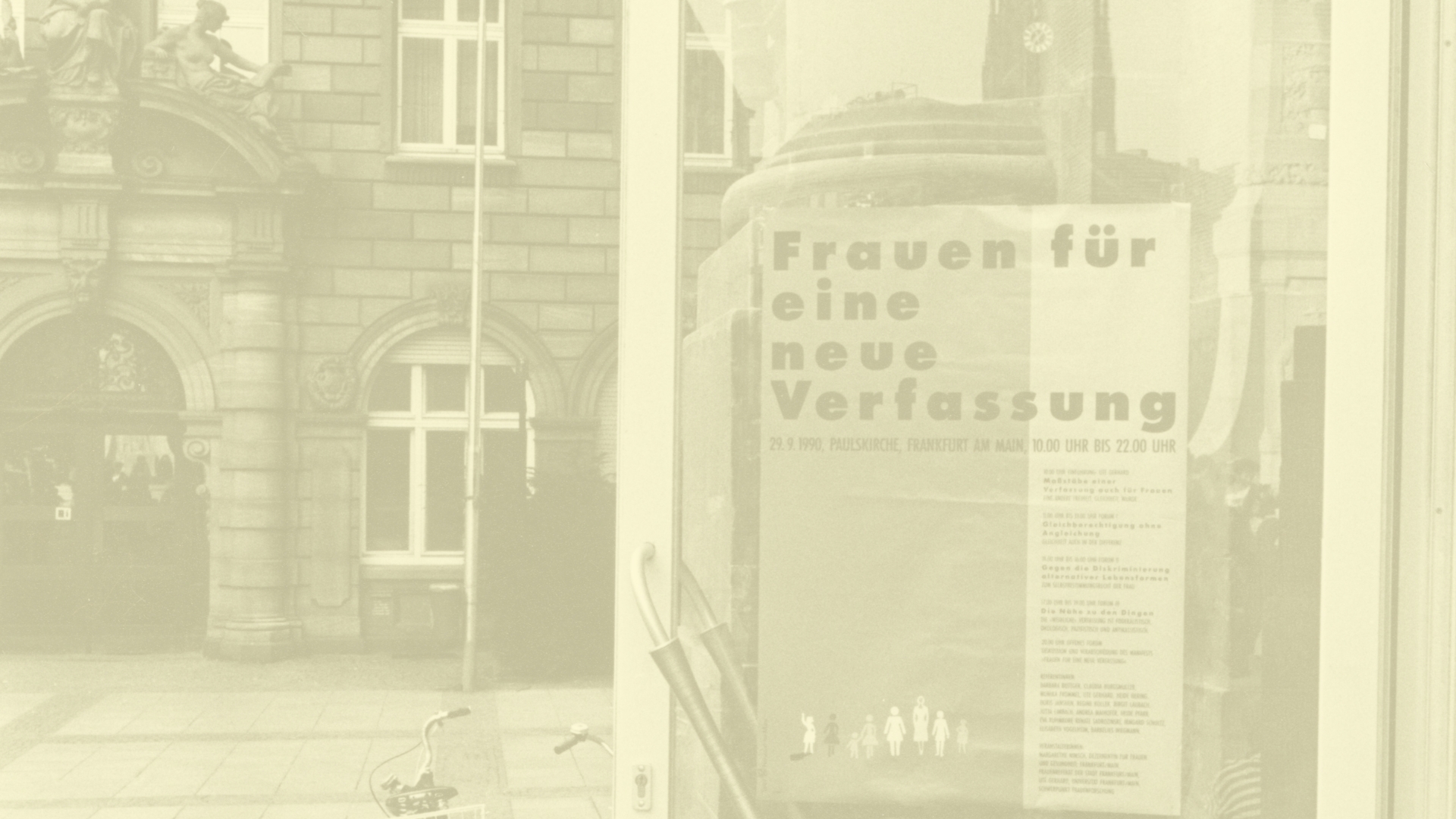
Possible constitutional amendments were discussed in many places, for example at various women's congresses. One of these was the “Women for a New Constitution” congress, which took place in Frankfurt's Paulskirche in September 1990.
Informationen über die verwendeten Medien
Plakat für den Kongress "Frauen für eine neue Verfassung" an der Frankfurter Paulskirche
From the collection of
How can I use the object
Rights information
Ursula Hillmann
Description
Fotografie eines Plakates für den Kongress "Frauen für eine neue Verfassung" an der Tür der Frankfurter Paulskirche
Object information
Type
Fotografie
Topic
Wiedervereinigung, Gleichberechtigung, Frankfurt, Frauenkongress
Material/Technique
Silbergelatineabzug
Participants, location and time information
Involved persons and organizations
Ursula Hillmann
Time
1990
Location
Frankfurt
Informationen über die verwendeten Medien
Frauen in bester Verfassung
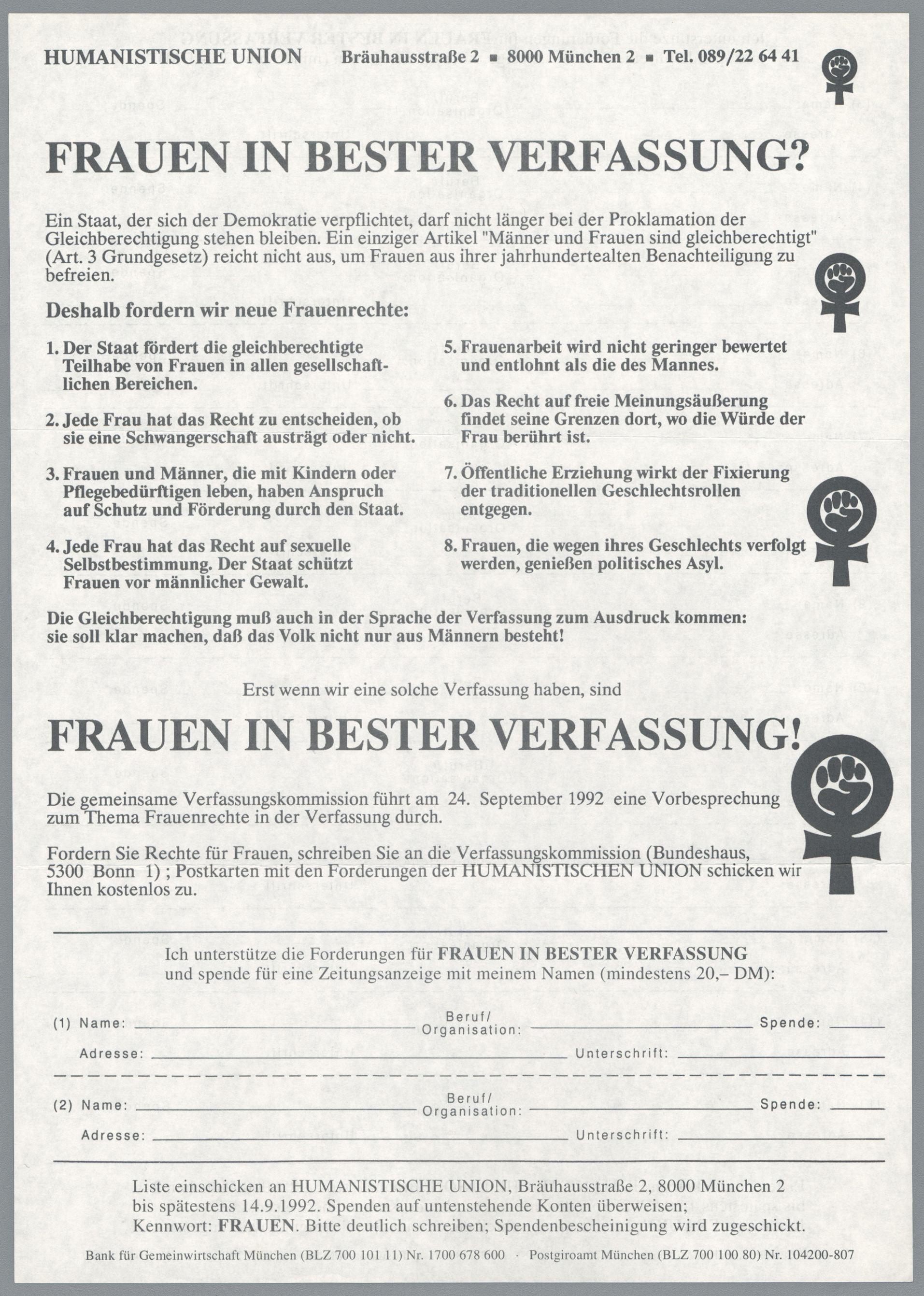
Flugblatt der humanistischen Union: Frauen in bester Verfassung
From the collection of
How can I use the object
Rights information
Archiv der deutschen Frauenbewegung
Object information
Type
Schriftgut
Topic
Gleichberechtigung, Gemeinsame Verfassungskommission
Part of
Nachlass Eleonore Romberg
Dimensions/Extent
2 Seiten / 1 Blatt
Material/Technique
Papier
Language
Deutsch
Identifier
NL-P-18 ; 1-4/1
Participants, location and time information
Involved persons and organizations
Humanistische Union
Time
1992
“Women in Top Form?”
In addition to women's conferences and other discussion panels, initiatives drew public attention to the constitutional debate with information leaflets. One of these was the initiative “Frauen in bester Verfassung” (“Women in Top Form”).
Informationen über die verwendeten Medien
Postkarte: Frauenrechte in die Verfassung!
Rote Postkarte der Arbeitsgemeinschaft sozialdemokratischer Frauen mit Forderungen nach einer Überarbeitung der Verfassung, ca. 1993
From the collection of
How can I use the object
Rights information
Archiv der deutschen Frauenbewegung
Object information
Type
Schriftgut, Postkarte
Topic
Gleichberechtigung, Grundgesetz, Gemeinsame Verfassungskommission
Part of
Nachlass Eleonore Romberg
Dimensions/Extent
2 Seiten / 1 Blatt
Material/Technique
Papier
Language
Deutsch
Identifier
NL-P-18 ; 1-4/3
Participants, location and time information
Involved persons and organizations
Arbeitsgemeinschaft sozialdemokratischer Frauen
Time
ca. 1993
We demand equality!
Many women's initiatives expressed demands for the inclusion of further women's rights in the constitution. These were intended to enable a truly equal society.
Particularly important was the demand to make measures for the advancement of women constitutionally permissible. In addition, the state itself should be obliged to take action: It should be tasked with actively establishing equality.
Informationen über die verwendeten Medien
Postkarte: Frauenrechte in die Verfassung
Rückseite: Rote Postkarte der Arbeitsgemeinschaft sozialdemokratischer Frauen mit Forderungen nach einer sprachlichen Überarbeitung der Verfassung und Verwendung von weiblichen Formulierungen
From the collection of
How can I use the object
Rights information
Archiv der deutschen Frauenbewegung
Object information
Type
Schriftgut, Postkarte
Topic
Gleichberechtigung, Gemeinsame Verfassungskommission
Part of
Nachlass Eleonore Romberg
Dimensions/Extent
2 Seiten / 1 Blatt
Material/Technique
Papier
Language
Deutsch
Identifier
NL-P-18 ; 1-4/3
Participants, location and time information
Involved persons and organizations
Arbeitsgemeinschaft sozialdemokratischer Frauen / SPD
Time
ca. 1993
Informationen über die verwendeten Medien
4.1 Ulrike Lembke: Forderungen von Frauen, AddF Kassel, 2025
From the collection of
How can I use the object
Rights information
Archiv der deutschen Frauenbewegung
Object information
Type
Interview
Language
Deutsch
Participants, location and time information
Time
2025
Location
Kassel
Still no parity
On January 16, 1990, the Joint Constitutional Commission convened. It discussed amendments to the Basic Law in the context of reunification. This included amending the article on equal rights.
Its members were members of the Bundestag and Bundesrat. Contrary to many demands, however, the commission was not composed of equal numbers of men and women. When the committee met, only 11 of the 64 members were women.
Informationen über die verwendeten Medien
Zeitungsartikel: Politikerinnen wollen mehr
Zeitungsartikel von Susanne Geiger, in Allgemeine Zeitung vom 16.05.1992: Gleichberechtigung. Politikerinnen wollen mehr
From the collection of
How can I use the object
Rights information
Archiv der deutschen Frauenbewegung
Object information
Type
Schriftgut, Zeitungsartikel
Topic
Gleichberechtigung, Gemeinsame Verfassungskommission
Part of
Nachlass Eleonore Romberg
Dimensions/Extent
2 Seiten / 1 Blatt
Material/Technique
Papier
Language
Deutsch
Identifier
NL-P-18 ; 1-4/2
Participants, location and time information
Time
16.05.1992
Alles, was Frauen machen, müssen sie doppelt so gut machen wie Männer. – Zum Glück ist das nicht schwer.
Heide Hering in ihrer Ansprache als Sachverständige der Gemeinsamen Verfassungskommission, 5. öffentliche Anhörung, 5. Nov. 1992
Informationen über die verwendeten Medien
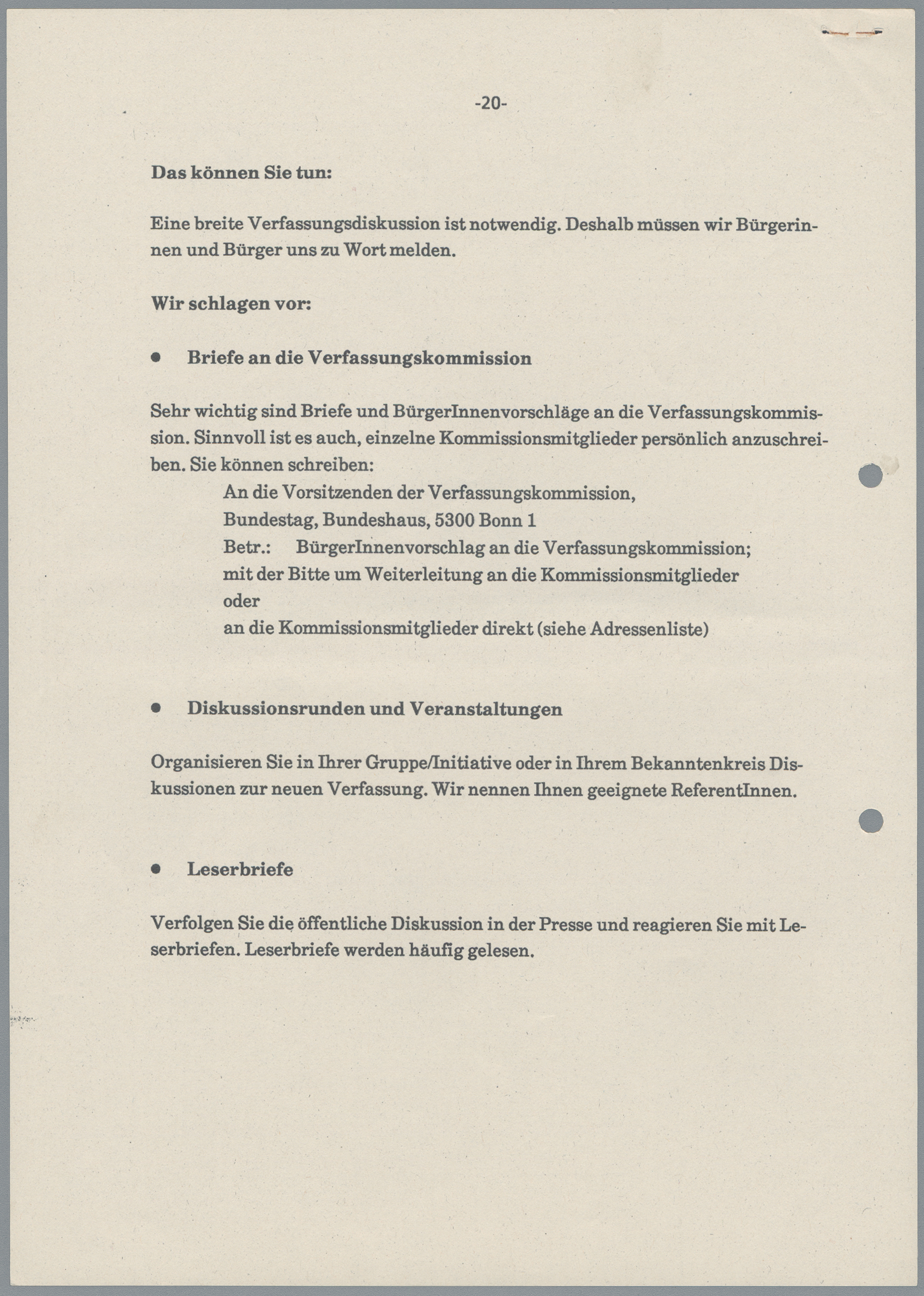
Handlungsaufforderung an die Bürgerinnen und Bürger
Seite 20 aus der Informationsbroschüre: Für eine neue Verfassung. Änderungs- und Ergänzungsvorschläge zum Grundgesetz, hrsg. von der Gleichstellungsstelle für Frauen der Landeshauptstadt München, 1992
From the collection of
How can I use the object
Rights information
Archiv der deutschen Frauenbewegung
Object information
Type
Schriftgut, Informationsbroschüre
Topic
Gleichberechtigung, Grundgesetz, Gemeinsame Verfassungskommission
Part of
Nachlass Eleonore Romberg (Informationsbroschüre: Für eine neue Verfassung. Änderungs- und Ergänzungsvorschläge zum Grundgesetz, hrsg. von der Gleichstellungsstelle für Frauen der Landeshauptstadt München, 1992)
Dimensions/Extent
2 Seiten / 1 Blatt
Material/Technique
Papier
Language
Deutsch
Identifier
NL-P-18 ; 1-2/1
Participants, location and time information
Involved persons and organizations
Gleichstellungsstelle für Frauen der Landeshauptstadt München
Time
1992
Location
München
“This is what you can do”
Repeatedly, initiatives and organizations called on the public to support women's demands. Their commitment paid off: Many submissions on the subject of equal rights reached the Joint Constitutional Commission.
A success?
Ultimately, the Joint Constitutional Commission issued a recommendation to amend Article 3(2). This amendment was adopted in 1994. It called on the state to promote the implementation of equal rights. However, there was no assurance that measures to promote women were explicitly permissible. Opponents of the representation feared that it would disadvantage men.
The utilization of promotional instruments, such as quotas for women, thus remained dependent on interpretation by legislators, administrators, and courts.
Informationen über die verwendeten Medien
4.3 Ulrike Lembke: Die Erweiterung des Artikels, AddF Kassel, 2025
From the collection of
How can I use the object
Rights information
Archiv der deutschen Frauenbewegung
Object information
Type
Interview
Language
Deutsch
Participants, location and time information
Time
2025
Location
Kassel
Männer und Frauen sind gleichberechtigt.
Der Staat fördert die tatsächliche Durchsetzung der Gleichberechtigung von Frauen und Männern und wirkt auf die Beseitigung bestehender Nachteile hin.
Art. 3 Abs. 2 GG seit der Ergänzung im Jahr 1994
Informationen über die verwendeten Medien
4.3 Ulrike Lembke: Die Erweiterung des Artikels, AddF Kassel, 2025
From the collection of
How can I use the object
Rights information
Archiv der deutschen Frauenbewegung
Object information
Type
Interview
Language
Deutsch
Participants, location and time information
Time
2025
Location
Kassel
Informationen über die verwendeten Medien
Zeitungsartikel: "Auf der anderen Insel"
Zeitungsartikel von Gisela Dachs in Die Zeit vom 28.08.1992: Auf der anderen Insel. Die Frauen aus Ost und West streiten über eine Reform des Grundgesetzes
From the collection of
How can I use the object
Rights information
Archiv der deutschen Frauenbewegung
Object information
Type
Schriftgut, Zeitungsartikel
Topic
Gleichberechtigung, Gemeinsame Verfassungskommission
Part of
Nachlass Eleonore Romberg
Dimensions/Extent
2 Seiten / 1 Blatt
Material/Technique
Papier
Language
Deutsch
Identifier
NL-P-18 ; 1-4/5
Participants, location and time information
Time
28.08.1992
The circle closes
In the summer of 1992, around 200 women from politics, business, and women's associations met on the island of Frauenchiemsee at the invitation of the SPD. Here, in the immediate vicinity of Herrenchiemsee, they discussed the need to reform the first all-German constitution. The movement thus made a conscious reference to the work on the Basic Law in 1948. It deliberately countered the exclusion of women at that time with its presence on Frauenchiemsee.
The action in the Joint Constitutional Commission was similarly symbolic: Following the protest initiated by Elisabeth Selbert and Herta Gotthelf in the Parliamentary Council, two large (laundry) baskets containing women's petitions for equal rights were handed over to the commission.
Informationen über die verwendeten Medien
4.4 Gespräch mit Prof. Dr. Ute Gerhard über die Ergänzung von Art. 3 Abs. 2 GG, AddF Kassel, 2025
From the collection of
How can I use the object
Rights information
https://addf-kassel.de/
Object information
Type
Interview
Language
Deutsch
Participants, location and time information
Time
2025
Location
Kassel
Informationen über die verwendeten Medien
Plakat für den Kongress "Frauen für eine neue Verfassung" an der Frankfurter Paulskirche
From the collection of
How can I use the object
Rights information
Ursula Hillmann
Object information
Type
Fotografie
Topic
Wiedervereinigung, Gleichberechtigung, Frankfurt, Frauenkongress, Grundgesetz
Participants, location and time information
Involved persons and organizations
Ursula Hillmann
Time
1990
Location
Frankfurt
Think about it!
What if...
...the 1994 expansion hadn't taken place?
...there had been more women on the Joint Constitutional Commission?
...Article 3, Section 2 of the Basic Law didn't exist?
Informationen über die verwendeten Medien
4.5 Ulrike Lembke: Was wäre, wenn?, AddF Kassel, 2025
From the collection of
How can I use the object
Rights information
Archiv der deutschen Frauenbewegung
Object information
Type
Interview
Language
Deutsch
Participants, location and time information
Time
2025
Location
Kassel
Informationen über die verwendeten Medien
Wie wichtig ist die Gleichberechtigung im Grundgesetz?
From the collection of
How can I use the object
Rights information
Archiv der deutschen Frauenbewegung
Object information
Type
Interview
Language
Deutsch
Participants, location and time information
Time
2025
Location
Kassel
Informationen über die verwendeten Medien
Parlamentarischer Rat, Sitzung des Hauptausschusses
From the collection of
How can I use the object
Rights information
Stiftung Haus der Geschichte der Bundesrepublik Deutschland / Erna Wagner-Hehmke
Object information
Type
Fotografie
Topic
Parlamentarischer Rat, Grundgesetz, Pädagogische Akademie, SPD, Bonn
Part of
Bestand Erna Wagner-Hehmke
Dimensions/Extent
6 x 6 cm
Material/Technique
Kunststoff
Identifier
1987/1/32.0131
Participants, location and time information
Involved persons and organizations
Erna Wagner-Hehmke
Time
23.02.1949
Location
Bonn
Further information
Recommended Reading
Our recommended reading (in German)
Herrenchiemsee
Einsichten und Perspektiven. Bayerische Zeitschrift für Politik und Geschichte. Themenheft: 75 Jahre Verfassungskonvent von Herrenchiemsee, 1/23 online unter: Bayerische Landeszentrale für Politische Bildungsarbeit
Augustiner-Chorherrenstift (Altes Schloss): Der Wille zu Freiheit und Demokratie – der Verfassungskonvent von Herrenchiemsee 1948, online unter: Herrenchimsee
Parlamentarischen Rat
Karin Gille-Linne: Verdeckte Strategien. Herta Gotthelf, Elisabeth Selbert und die Frauenarbeit der SPD 1945-1949, Bonn 2011
bpb: Grundgesetz und Parlamentarischer Rat
HdG: Bilder zum Parlamentarischen Rat
Arbeit am ersten Gleichberechtigungsgesetz
Johannes Kühle: Lächelnd gegen das Patriarchat. Bundesverfassungsrichterin Erna Scheffler (1893-1986), online unter: ForumRecht
Till van Rahden: Demokratie und väterliche Autorität. Das Karlsruher „Stichentscheid“-Urteil von 1959 in der politischen Kultur der frühen Bundesrepublik, in: Zeithistorische Forschungen (ZF) 2005, 160-179, online unter: Zeithistorische Forschungen
Erweiterung von Art. 3 Abs 2
Happy Birthday, Gleichstellungsauftrag (Art. 3 Abs. 2 Satz 2 GG)?, Policy Paper: 24-38 des Deutschen Juristinnenbundes online unter: Deutscher Juristinnenbund
Jessica Bock: In welchem Staat wollen wir leben? Feministische Verfassungsdebatten – von der historischen Chance zur Enttäuschung, in: Digitales Deutsches Frauenarchiv, online unter: Digitales Deutsches Frauenarchiv
Unsere Interviews - Langfassungen
Informationen über die verwendeten Medien
5.3 Interview mit Dr. Manuela Rienks, Onlineausstellung Gleichberechtigung, AddF Kassel, 2025
From the collection of
How can I use the object
Rights information
Archiv der deutschen Frauenbewegung
Object information
Type
Interview
Language
Deutsch
Participants, location and time information
Time
2025
Location
Kassel
Informationen über die verwendeten Medien
5.1 Interview mit Dr. Karin Gille-Linne, Onlineausstellung Gleichberechtigung, AddF Kassel, 2025
From the collection of
How can I use the object
Object information
Type
Interview
Language
Deutsch
Participants, location and time information
Time
2025
Location
Kassel
Informationen über die verwendeten Medien
5.2 Interview mit Dr. Eva Balz, Onlineausstellung Gleichberechtigung, AddF Kassel, 2025
From the collection of
How can I use the object
Rights information
Archiv der deutschen Frauenbewegung
Object information
Type
Interview
Language
Deutsch
Participants, location and time information
Time
2025
Location
Kassel
Informationen über die verwendeten Medien
5.5 Interview mit Prof. Dr. Ute Gerhard, Onlineausstellung Gleichberechtigung, AddF Kassel, 2025
From the collection of
How can I use the object
Rights information
Archiv der deutschen Frauenbewegung
Object information
Type
Interview
Language
Deutsch
Participants, location and time information
Time
2025
Location
Kassel
Informationen über die verwendeten Medien
5.4 Interview mit Prof. Dr. Ulrike Lembke, Onlineausstellung Gleichberechtigung, AddF Kassel, 2025
From the collection of
How can I use the object
Rights information
Archiv der deutschen Frauenbewegung
Object information
Type
Interview
Language
Deutsch
Participants, location and time information
Time
2025
Location
Kassel
All interviews in English translation
Informationen über die verwendeten Medien
1.1 Manuela Rienks: Who was Part of the Group of Experts, AddF Kassel, 2025
From the collection of
How can I use the object
Rights information
Archiv der deutschen Frauenbewegung
Object information
Type
Interview
Participants, location and time information
Involved persons and organizations
Archiv der deutschen Frauenbewegung
Time
2025
Location
Kassel
Informationen über die verwendeten Medien
1.3 Manuela Rienks: 'civil' and 'fundamentally', AddF Kassel, 2025
From the collection of
How can I use the object
Rights information
Archiv der deutschen Frauenbewegung
Object information
Type
Interview
Informationen über die verwendeten Medien
1.4 Manuela Rienks: No Women on the Herreninsel, AddF Kassel, 2025
From the collection of
How can I use the object
Rights information
Archiv der deutschen Frauenbewegung
Informationen über die verwendeten Medien
1.5 Manuela Rienks: What if?, AddF Kassel, 2025
From the collection of
How can I use the object
Rights information
Archiv der deutschen Frauenbewegung
Informationen über die verwendeten Medien
2.2 Karin Gille-Linne: Women in the Parliamentary Council, AddF Kassel, 2025
From the collection of
How can I use the object
Rights information
Archiv der deutschen Frauenbewegung
Informationen über die verwendeten Medien
2.3 Karin Gille-Linne: Where does the wording originate from?, AddF Kassel, 2025
From the collection of
How can I use the object
Rights information
Archiv der deutschen Frauenbewegung
Informationen über die verwendeten Medien
2.4 Karin Gille-Linne: The Debate in the Main Committee, AddF Kassel, 2025
From the collection of
How can I use the object
Rights information
Archiv der deutschen Frauenbewegung
Informationen über die verwendeten Medien
2.5 Karin Gille-Linne: „laundry baskets“, AddF Kassel, 2025
From the collection of
How can I use the object
Rights information
Archiv der deutschen Frauenbewegung
Informationen über die verwendeten Medien
2.6 Karin Gille-Linne: What if?, AddF Kassel, 2025
From the collection of
How can I use the object
Rights information
Archiv der deutschen Frauenbewegung
Informationen über die verwendeten Medien
3.1 Eva Balz: Casting Votes, AddF Kassel, 2025
From the collection of
How can I use the object
Rights information
Archiv der deutschen Frauwenbewegung
Informationen über die verwendeten Medien
3.3 Eva Balz: Political Parties and the Principle of Equal Rights, AddF Kassel, 2025
Interview with Dr. Eva Balz
From the collection of
How can I use the object
Rights information
Archiv der deutschen Frauenbewegung
Informationen über die verwendeten Medien
3.4 Eva Balz: The Ruling of the Federal Constitutional Court, AddF Kassel, 2025
Interview with Dr. Eva Balz
From the collection of
How can I use the object
Rights information
Archiv der deutschen Frauenbewegung
Informationen über die verwendeten Medien
3.5 Eva Balz: What if?, AddF Kassel, 2025
Interview with Dr. Eva Balz
From the collection of
How can I use the object
Rights information
Archiv der deutschen Frauenbewegung
Informationen über die verwendeten Medien
4.1 Ulrike Lembke: Women's Demands, AddF Kassel, 2025
Interview with Prof. Dr. Ulrike Lemke
From the collection of
How can I use the object
Rights information
Archiv der deutschen Frauenbewegung
Informationen über die verwendeten Medien
4.2 Ulrike Lembke: Measures to Promote Women, AddF Kassel, 2025
Interview with Prof. Dr. Ulrike Lemke
From the collection of
How can I use the object
Rights information
Archiv der deutschen Frauenbewegung
Informationen über die verwendeten Medien
4.3 Ulrike Lembke: The Extension of Art. 3 Basic Law, AddF Kassel, 2025
Interview with Prof. Dr. Ulrike Lemke
From the collection of
How can I use the object
Rights information
Archiv der deutschen Frauenbewegung
Informationen über die verwendeten Medien
4.4 Talk with Prof. Dr. Ute Gerhard on the extension of Art. 3 Basic Law, AddF Kassel, 2025
Interview with Prof. Dr. Ute Gerhard
From the collection of
How can I use the object
Rights information
Archiv der deutschen Frauenbewegung
Informationen über die verwendeten Medien
4.5 Ulrike Lembke: What if?, AddF Kassel, 2025
Interview with Prof. Dr. Ulrike Lemke
From the collection of
How can I use the object
Rights information
Archiv der deutschen Frauenbewegung
Informationen über die verwendeten Medien
Of how much importance is equality in the Basic Constitutional Law? AddF Kassel, 2025
Of how much importance is equality in the Basic Constitutional Law?
From the collection of
How can I use the object
Rights information
Archiv der deutschen Frauenbewegung
Informationen über die verwendeten Medien
5.1 Interview with Dr. Karin Gille-Linne, online exhibition on equality, AddF Kassel, 2025
The full Interview with Dr. Karin Gille-Linne,
From the collection of
How can I use the object
Rights information
Archiv der deutschen Frauenbewegung
Informationen über die verwendeten Medien
5.2 Interview with Dr. Eva Balz, online exhibition on equality, AddF Kassel, 2025
The full Interview with Dr. Eva Balz
From the collection of
How can I use the object
Rights information
Archiv der deutschen Frauenbewegung
Informationen über die verwendeten Medien
5.3 Interview with Dr. Manuela Rienks, online exhibition on equality, AddF Kassel, 2025
The full Interview with Dr. Manuela Rienks
From the collection of
How can I use the object
Rights information
Archiv der deutschen Frauenbewegung
Informationen über die verwendeten Medien
5.4 Interview with Prof. Dr. Ulrike Lembke, online exhibition on equality, AddF Kassel, 2025
The full Interview with Prof. Dr. Ulrike Lembke
From the collection of
How can I use the object
Rights information
Archiv der deutschen Frauenbewegung
Informationen über die verwendeten Medien
Interview with Prof. Dr. Ute Gerhard, online exhibition on equality, AddF Kassel, 2025
The full Interview with Prof. Dr. Ute Gerhard
From the collection of
How can I use the object
Rights information
Archiv der deutschen Frauenbewegung
A virtual exhibition of
Team
Christina Ramsch
Dr. Kerstin Wolff
Laura Baumgarten (Videoschnitt und -bearbeitung)
Chiara Wendt (Übersetzung)
Silke Mehrwald, Tamara Block, Barbara Günther, Michaela Wilhelm, Chiara Wendt (Digitales Sammlungsmanagement und Bildrecherche)
Imprint
Archiv der deutschen Frauenbewegung
Gottschalkstraße 57
D-34127 Kassel
Silke Mehrwald, Laura Schibbe, Jacqueline Weil, Dr. Kerstin Wolff
+49 (0)561-989 36 70
+49 (0)561-989 36 72
Als Anbieter von DDBstudio verantwortlich im Sinne des Medienstaatsvertrags:
Stiftung Preußischer Kulturbesitz, gesetzlich vertreten durch ihren Vizepräsidenten, handelnd für das durch Verwaltungs- und Finanzabkommen zwischen Bund und Ländern errichtete Kompetenznetzwerk
Deutsche Digitale Bibliothek
c/o Stiftung Preußischer Kulturbesitz
Von-der-Heydt-Straße 16-18
10785 Berlin
Telefon: +49 (0)30 266-41 1432, Fax: +49 (0) 30 266-31 1432
E-Mail: geschaeftsstelle@deutsche-digitale-bibliothek.de
FIZ Karlsruhe - Leibniz Institut für Informationsinfrastruktur GmbH
Hermann-von-Helmholtz-Platz 1
76344 Eggenstein-Leopoldshafen
Die Deutsche Digitale Bibliothek verlinkt die virtuelle Ausstellung auf ihrer Internetseite https://www.deutsche-digitale-bibliothek.de/content/virtuelle-ausstellungen.
Die kuratierende Einrichtung bestimmt über Thema und Inhalt der Einstellung. Die DDB nimmt nur im Ausnahmefällen Einfluss darauf, s. Nutzungsbedingungen.